
How Generative AI is Transforming Businesses Globally?
-
 Freya Jane
- Director of Customer's Success
Advances in artificial intelligence, especially generative AI and its applications, like ChatGPT, are causing a major shift in the business landscape. Companies are coming up with creative ways to use this technology to give their clients outstanding value.
“The use of AI models has directly contributed to a startling 45% increase in business earnings between January and April of 2023.”
This increase is indicative of how AI is revolutionising businesses, increasing productivity, and eventually driving profitability.
Generative AI shows itself as a vital tool for companies managing the complexity of trade compliance as trade laws get more complicated and data quantities keep growing.
iCustoms Leading the charge
As the global trade economy grows, iCustoms is leading the way in implementing cutting-edge technologies and transforming the customs technology sector.
Recent Advances in the Use of Generative AI in Trade Compliance
Here are some ways generative AI is used in the trade compliance industry:
Automation
One of the ways that generative AI is impacting the trade compliance industry is through the automation of compliance processes. Traditionally, trade compliance processes were very manual, and it took a lot of time and money to ensure that all rules were followed.
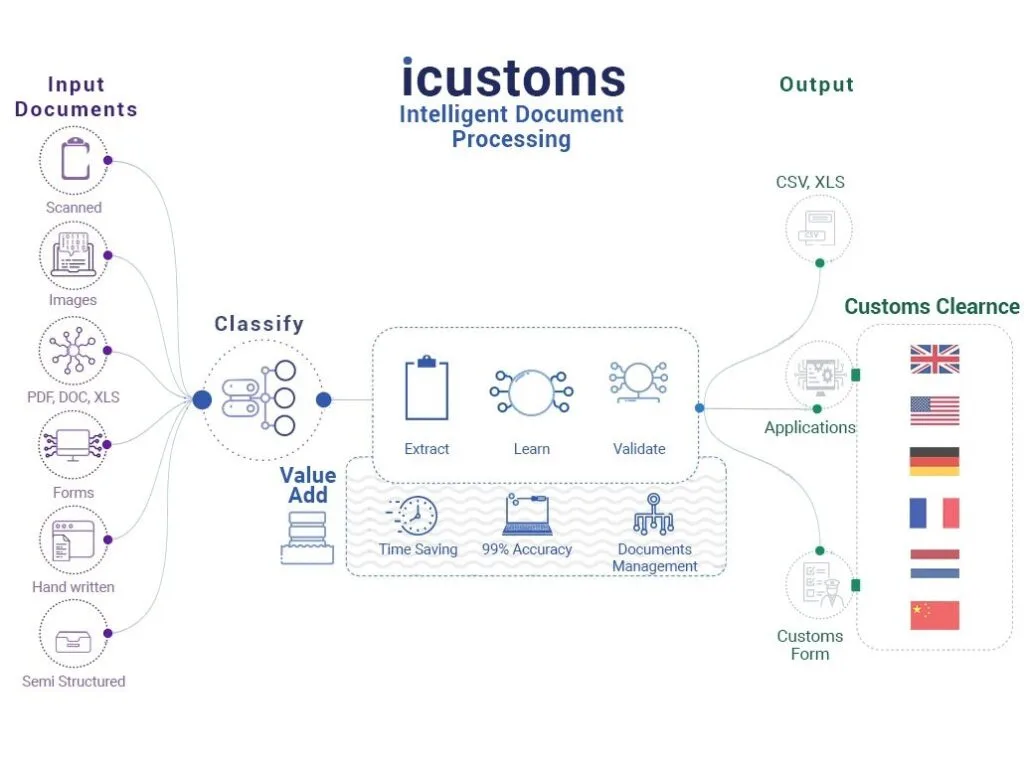
With generative AI, businesses can automate a lot of these tasks, which lowers the chance of mistakes and speeds up compliance checks. In its Intelligent Document Processing module, for example, iCustoms uses AI to automate the processing of documents.
IDP takes information from any customs document in any format (image, semi-structured, PDF, XLS, etc.) and fills in customs declarations in seconds with 99% accuracy.
Risk management
Generative AI can also improve risk management in the trade compliance industry. AI can find areas of risk for businesses, like transactions that may be more likely to break trade rules, by analysing a lot of data from various sources.
This can help businesses better manage risk and ensure they stay in line with trade laws and rules.
iCustoms AI Rules Engine functionality assesses transactions against thousands of customs rules in real-time, ensuring the accuracy of 99% of customs declarations. This is ground-breaking technology.
HS code lookup
Finding and allocating the correct HS codes is one of the main challenges in the trade compliance industry.
There are legal implications for using incorrect HS codes and, as a result, paying incorrect duties and taxes.
HS lookup service is the most advanced tool in the market, which requires only the product name to predict the HS codes with an accuracy of over 95%. It uses multiple layers of machine learning and AI technologies, including generative AI.
It analyses the features and characteristics of a product and generates a detailed description that includes information about its composition, materials, intended use, and other relevant details. This description is then used to determine the appropriate HS code in real time.
Generative AI helps streamline the HS code-finding process and reduce the risk of errors or misclassification, ultimately saving time and money for businesses involved in international trade.
Conclusion
In conclusion, generative AI could change the customs technology industry in a lot of interesting ways.
However, it is essential that businesses use generative AI responsibly and carefully to ensure that it is used to promote the public good and not to harm it.
Email the iCustoms team at info@icustoms.ai to learn how we are revolutionising the trade compliance business with AI and cutting-edge technologies.
Frequently Asked Questions
What is generative AI and how does it apply to trade compliance?
Generative AI is a category of artificial intelligence that produces outputs such as text, classifications, and structured data based on learned patterns. In trade compliance, it applies to automating document processing, predicting HS codes, assessing transaction risk, and generating accurate customs declarations, reducing manual effort and the likelihood of regulatory errors.
How does AI automate customs document processing?
AI-powered Intelligent Document Processing (IDP) extracts data from any customs document format, including PDFs, images, spreadsheets, and semi-structured files, and populates customs declarations in seconds. iCustoms IDP achieves 99% accuracy, removing the need for manual data entry and significantly cutting processing time across import and export workflows.
How does generative AI improve risk management in trade compliance?
Generative AI analyses large volumes of transaction data in real time to identify patterns that indicate elevated compliance risk, such as transactions likely to breach trade regulations. iCustoms AI Rules Engine assesses each transaction against thousands of customs rules simultaneously, flagging issues before submission and ensuring declarations reach 99% accuracy.
How does AI find the correct HS code for a product?
iCustoms HS code lookup requires only a product name. The AI uses multiple layers of machine learning and generative AI to analyse a product's composition, materials, and intended use, generating a detailed description that maps to the correct HS code in real time. This approach achieves over 95% classification accuracy, reducing misclassification risk.
What are the legal risks of using incorrect HS codes?
Using an incorrect HS code results in paying the wrong rate of duty and tax, which can trigger HMRC or Revenue audits, post-clearance demand notices, and financial penalties. In serious cases, repeated misclassification may constitute a customs offence. AI-powered classification tools reduce this risk by predicting codes accurately before submission.
How has AI contributed to business earnings in trade and other sectors?
According to research cited by Forbes, direct use of AI models contributed to a 45% increase in business earnings between January and April 2023. In trade specifically, AI reduces the cost of compliance, accelerates declaration processing, and minimises costly errors, translating directly into improved margins for customs agents, traders, and carriers.
Can businesses use generative AI responsibly in customs and trade?
Yes. Responsible use of generative AI in trade compliance means deploying it within governed workflows, maintaining human oversight for complex or high-value shipments, and ensuring outputs are auditable. iCustoms embeds compliance rules and accuracy thresholds directly into its AI models, ensuring automation supports regulatory adherence rather than bypassing it.
You may also like:



Subscribe to our Newsletter
About iCustoms
iCustoms is an all-in-one solution helping businesses automate customs processes more efficiently. With AI-powered and machine-learning capabilities, iCustoms is designed to streamline your all customs procedures in a few minutes, cut additional costs and save time.