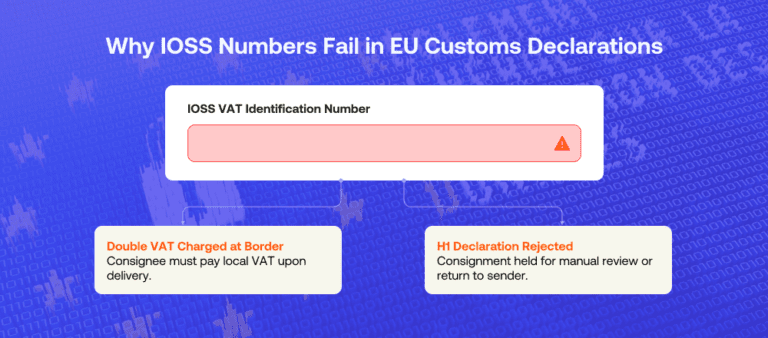
IOSS Customs Declaration Errors Go Beyond Filing Mistakes
- John Hall
- Customs Specialist at iCustoms.ai
From 1 July 2026, the risk profile for low-value EU imports changes materially. While much discussion centres on the €3 per tariff sub-heading rule, the more structural shift lies in EU customs declaration data validation. Customs authorities are increasingly comparing structured datasets across systems before clearance, exposing IOSS data mismatch that previously remained invisible.
The Import One Stop Shop continues to simplify VAT collection for EU imports. However, rising IOSS compliance risk 2026 stems from inconsistencies between invoices, payment records, security filings, and import declarations. At scale, these inconsistencies generate repeatable IOSS declaration errors that automated systems detect immediately.
The Hidden Cause of IOSS Declaration Errors
IOSS declaration errors rarely originate from VAT logic itself. They emerge when manual filings and fragmented upstream systems feed inconsistent data into the EU import declaration workflow. Under structured customs data validation via state-of-the-art AI powered automation software, customs systems compare fields, not intent.
The European Commission has stated that customs supervision is transitioning toward digital cross-system validation. In that environment, data integrity becomes the primary control variable.
Multi-System Data Fragmentation
Most e-commerce imports interact with at least four independent datasets:
- Marketplace product listing
- Commercial invoice
- Payment processor record
- Logistics shipment file
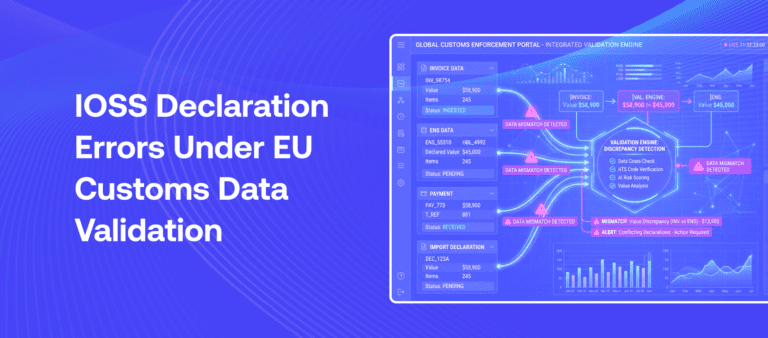
When descriptions, quantities, or declared values differ across these sources, the final customs declaration reflects structural inconsistency. That inconsistency becomes a measurable IOSS data mismatch under automated EU customs declaration data validation.
Why Volume Magnifies IOSS Compliance Risk 2026 and Makes Customs Automation Essential
At small volumes, brokers can manually reconcile customs filing related discrepancies. At scale, reconciliation becomes a structural weakness rather than a safeguard. Spreadsheet corrections, SKU renaming, and inconsistent value allocation generate repeatable data variance.
Under ICS2 data validation and centralised enforcement models, repeated inconsistencies increase systemic IOSS compliance risk 2026. Automation of customs systems is no longer an efficiency upgrade; it becomes the only reliable mechanism to enforce structured data consistency before submission.
How EU Customs Declaration Data Validation Detects IOSS Data Mismatch
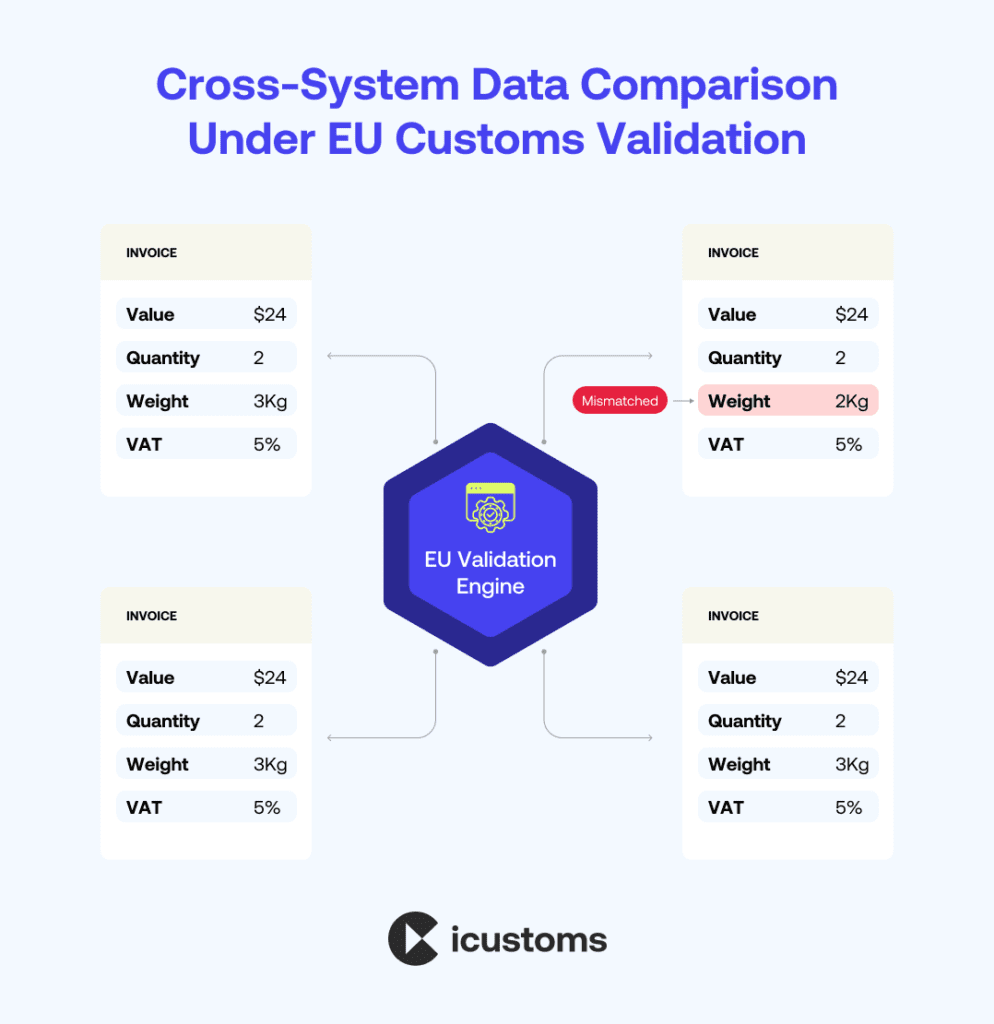
Customs authorities no longer assess declarations in isolation. They compare structured fields submitted across systems. The World Customs Organization Data Model promotes interoperable electronic datasets that enable automated cross-checking before goods are released. This structured comparison environment makes IOSS data mismatch operationally visible.
ICS2 Release 3 and Structured Validation
Under ICS2, Entry Summary Declarations are filed before arrival. Commodity descriptions, HS codes, weights, and consignee details are electronically assessed. If import declaration fields diverge materially from ENS data, validation flags may be triggered.
The issue is not miscalculated VAT. It is inconsistency across structured datasets.
Cross-Referencing VAT, ENS and Import Data
EU customs declaration data validation increasingly compares:
- ENS security filing data
- Import declaration structured fields
- IOSS VAT identification references
- Statistical trade patterns
This cross-referencing transforms isolated clerical errors into identifiable data integrity risks.
Where IOSS Declaration Errors Commonly Occur
In high-volume e-commerce customs clearance, recurring IOSS declaration errors typically arise from structured data inconsistencies rather than classification mistakes alone.
1. Description Variance
Marketplace descriptions optimised for conversion often differ from invoice descriptions used for customs purposes. Even if tariff classification is technically correct, inconsistent wording across systems can generate queries during EU customs declaration data validation.
2. Declared Value vs Payment Settlement
Discount allocation, currency rounding, and shipping cost treatment frequently diverge between checkout systems and customs declarations. When declared customs value does not reconcile with payment records, IOSS data mismatch becomes detectable.
3. Quantity and Weight Fields
Logistics systems may use gross shipment weight while invoices reference net product weight. If structured declaration fields conflict, automated validation systems flag inconsistency before clearance.
Table: Operational Triggers behind IOSS Data Mismatch
| Validation Layer | Source of Inconsistency | Resulting IOSS Declaration Error |
| Product Description | Listing vs invoice wording | Structured data mismatch flag |
| Customs Value | Checkout discount vs declared value | Entry amendment request |
| Quantity | Bundle logic vs unit declaration | Declaration rejection |
| Weight | Gross vs net variance | Clearance delay |
| VAT Reference | Incorrect IOSS formatting | VAT-at-border duplication risk |
This table reflects how customs document automation without pre-filing verification can amplify operational friction rather than reduce it.
Why Manual Controls Increase IOSS Compliance Risk 2026
Manual reconciliation processes are inherently inconsistent. Each correction cycle introduces human variability. In a digital validation environment, variability itself becomes detectable.
The European Commission has emphasised that EU customs reform aims to rely on “high-quality electronic data submitted prior to arrival.” Manual rework after rejection contradicts that objective and increases long-term compliance exposure.
Escalation Pathways
Recurring IOSS declaration errors may lead to:
- Additional information requests
- Repeated entry amendments
- Value justification queries
- Heightened customs scrutiny
Over time, this affects clearance predictability and operational margin.
Customs Document Automation Must Include Pre-Filing Validation
Customs document automation alone does not eliminate IOSS data mismatch. Automation that merely converts documents into declaration format without cross-verification replicates upstream errors at scale.
To reduce EU customs declaration data validation failures, automation must include:
- Structured data extraction from invoices
- Automated cross-verification against payment records
- Consistency checks between ENS and declaration data
- Audit-ready logging of corrections
This is where intelligent document processing customs systems act as a compliance firewall rather than a clerical shortcut.
The Three-Layer Model to Reduce IOSS Declaration Errors
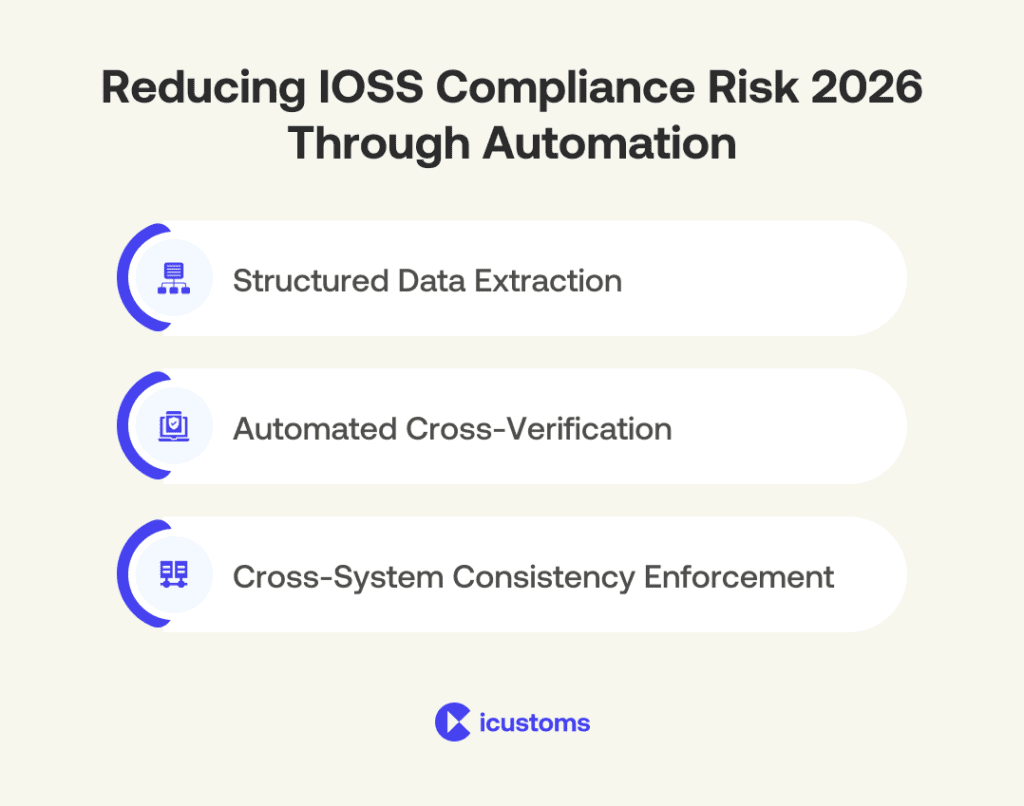
Reducing IOSS customs declaration errors requires a structured compliance architecture that prevents data mismatch before submission. A layered control model ensures invoice data integrity, cross-verification of transactional records, and alignment across customs systems. This approach transforms customs automation from a clerical tool into a proactive data-governance safeguard.
1. Structured Data Extraction
Intelligent document processing converts unstructured invoices into structured fields. This reduces transcription errors and improves customs data integrity at source.
2. Automated Cross-Verification
Systems must reconcile invoice totals, payment settlement values, quantities, and weight data before submission. Detecting IOSS data mismatch pre-filing reduces amendment cycles.
3. Cross-System Consistency Enforcement
Classification, valuation, and VAT reference fields must remain consistent across ENS, import declarations, and IOSS reporting. Alignment prevents EU customs declaration data validation disruption.
The 120-Day Readiness Question for IOSS Compliance Risk 2026
With July 2026 enforcement intensifying, organisations handling IOSS services for EU imports should assess whether their workflow can withstand structured validation pressure.
Key readiness indicators include:
- Automated detection of IOSS declaration errors before submission
- Integrated customs document automation with cross-verification logic
- ENS and import declaration data alignment
- Audit-traceable data governance
If reconciliation depends primarily on manual spreadsheet comparison, IOSS compliance risk 2026 remains structurally elevated.
What Is IOSS in a Customs Declaration?
The term IOSS in customs declaration refers to the inclusion of a valid Import One Stop Shop VAT identification number within the structured import declaration submitted to EU customs authorities. When goods valued at €150 or below are sold under the IOSS scheme, the IOSS VAT number must be transmitted electronically in the designated declaration data field.
An IOSS customs declaration is therefore not a different type of declaration. It is a standard EU import declaration that contains an IOSS VAT reference to confirm VAT was already collected at the point of sale. If the IOSS number is missing or incorrectly formatted, customs systems may treat the shipment as non-IOSS and charge VAT again at the border.
Where to Enter IOSS in the Customs Declaration Section
For operators asking how to enter IOSS in customs declaration section, the IOSS VAT identification number must be included in the dedicated data element field defined by national customs systems. Under the Union Customs Code data structure, this is typically transmitted electronically via customs software, not manually typed on paper forms.
The IOSS number is communicated:
- Through the import declaration message
- In alignment with the consignment reference
- Before clearance decision
Failure to enter the IOSS VAT registration number correctly may trigger VAT-at-border collection, clearance delays, or post-clearance correction.
IOSS VAT and the IOSS VAT Registration Number
IOSS VAT refers specifically to VAT collected at checkout for low-value B2C imports into the EU. The seller charges VAT according to the customer’s Member State rate and reports it through a single monthly IOSS return.
The IOSS VAT registration number is the unique identification number issued when a business registers for the Import One Stop Shop scheme. It serves as proof that VAT has already been collected and will be remitted centrally.
Important clarification:
- The IOSS VAT registration number is not the same as a domestic VAT number.
- It is used exclusively for low-value imported goods under the IOSS scheme.
- It must be transmitted securely to customs via the declarant or carrier.
Is an IOSS Number the Same as a VAT Number?
A common query is: Is IOSS number same as VAT number? No. An IOSS number is distinct from a standard EU VAT registration number.
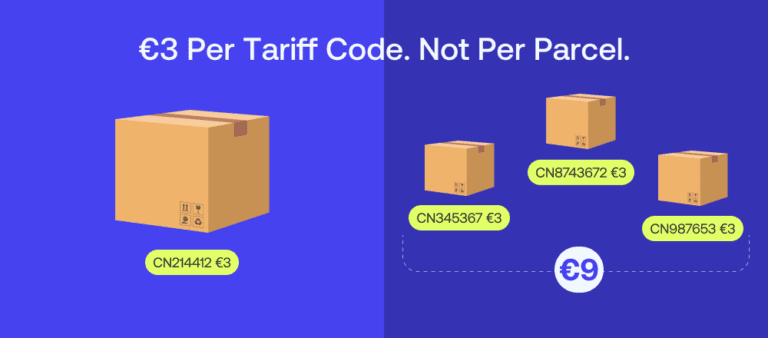
| Classification Depth | Tariff Sub-Headings | Customs Duty Outcome |
| Single CN heading | 1 | €3 |
| Bundle across 3 headings | 3 | €9 |
The IOSS number is designed for distance selling of imported goods under €150. It does not replace VAT registration for other taxable activities within the EU.
What Are IOSS Services in the Customs Context?
IOSS services typically refer to intermediary support, VAT registration management, monthly IOSS return filing, and structured customs integration to ensure the IOSS VAT reference is correctly transmitted in the customs declaration.
However, IOSS services should not be confused with customs duty calculation services. IOSS governs VAT reporting only. Customs duty, tariff classification, and data validation remain separate compliance obligations.
In high-volume environments, IOSS services increasingly integrate with:
- Customs document automation
- Intelligent document processing customs systems
- EU import declaration workflow platforms
- API or AS4 data exchange infrastructure
This integration ensures that the IOSS VAT registration number aligns consistently with structured customs data, reducing IOSS declaration errors caused by incorrect or missing VAT references.
Conclusion: IOSS Declaration Errors Are Data Governance Failures
The Import One Stop Shop remains a VAT simplification mechanism. It does not harmonise commercial data flows. Under strengthened EU customs declaration data validation, IOSS data mismatch becomes the dominant operational risk factor.
- IOSS simplifies VAT but does not eliminate data mismatch
- EU customs declaration data validation detects cross-system inconsistency
- IOSS declaration errors increase at scale without structured controls
- Customs document automation must include validation logic
- Intelligent document processing reduces pre-filing risk
iCustoms provides:
- Intelligent document processing customs infrastructure
- AI-driven classification consistency
- Structured EU import declaration workflow management
- API, EDI, and AS4 interoperability
- ISO 27001 and ISO 9001 governed compliance architecture
In the post-2026 environment, clearance stability depends less on filing speed and more on data integrity across systems.
Prepare your EU IOSS workflow for structured EU customs declaration data validation before July 2026.

Stop IOSS Declaration Errors at the Source
Use intelligent automation to prevent EU customs validation delays.
You may also like:
Struggling to Extract, Catagorise & Validate Your Documents?

Capture & Upload Data in Seconds with AI & Machine Learning
Subscribe to our Newsletter
About iCustoms
iCustoms is an all-in-one solution helping businesses automate customs processes more efficiently. With AI-powered and machine-learning capabilities, iCustoms is designed to streamline your all customs procedures in a few minutes, cut additional costs and save time.
Struggling to Extract, Catagorise & Validate Your Documents?
Capture & Upload Data in Seconds with AI & Machine Learning