
Mastering ICS2: A Guide to EU Import Requirements
- Freya Jane
- Director of Customer's Success
The European Union (EU) has significantly strengthened its border security framework in response to rising risks from terrorism, illicit trade, and supply-chain vulnerabilities. As part of evolving EU import requirements, the European Union implemented Import Control System 2 (ICS2), a mandatory advance cargo information system governing goods entering or transiting the EU.
Since 1 September 2025, ICS2 Release 3 has been fully deployed across all transport modes, making pre-arrival safety and security filings a legal requirement for importers involved in EU-bound trade. This new ICS2 system for imports or goods in transit is to assist with the implementation of the new Union Customs Code (UCC) processes and procedures.
With enforcement now fully in effect across most EU Member States, businesses that have not aligned their systems, data processes, and ENS filing responsibilities face increased risk of delays, rejections, and administrative penalties.
What is Import Control System 2 (ICS2) for EU Imports?
Import Control System 2 (ICS2) is the European Union’s advance cargo information system for safety and security risk management. It applies to all imports or goods entering or transiting the EU, including movements involving Northern Ireland, Norway, and Switzerland.
Under ICS2, all Economic Operators (EOs) are required to submit safety and security data through an Entry Summary Declaration (ENS) prior to arrival. This data is now routinely used by EU customs authorities to conduct pre-arrival and pre-loading risk analysis, enabling earlier intervention while facilitating legitimate trade.
Import Control System 2 (ICS2) Releases for Importers
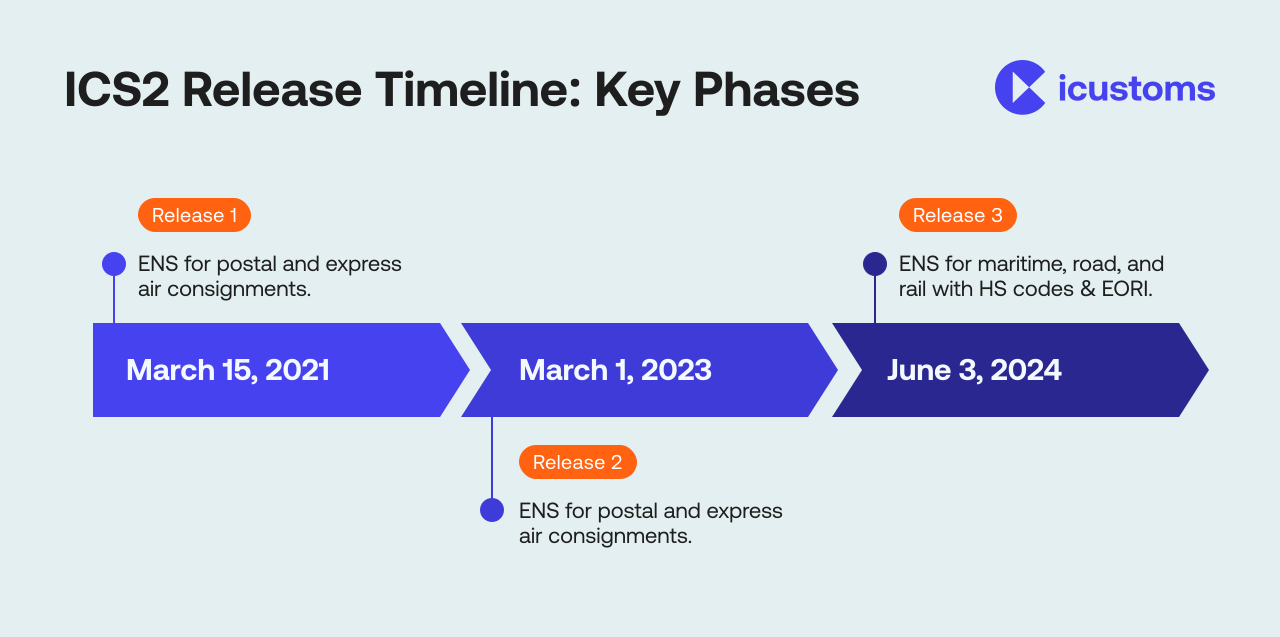
ICS2 for EU imports has been implemented through a phased rollout, with Release 3 completing the system’s coverage across all transport modes in September 2025. As of 2026, ICS2 is fully operational and enforced for EU imports and transit movements.
What was included in the ICS2 Releases 1 and 2?
The first release of ICS2 was implemented on March 15, 2021. This release was primarily for postal and express consignments travelling to or through the EU by air. It required them to complete the Entry Summary Declaration (also known as pre-loading advance cargo information, or PLACI) before being loaded onto an aircraft bound for the EU.
The second release of ICS2 came into effect on March 1, 2023. It required all air freight cargo general consignments to complete the PLACI form and the entire Entry Summary Declaration (ENS) data set before arriving in any of the EU-27 destinations as well as Northern Ireland, Norway, and Switzerland.
These releases established the operational foundation for ICS2 and remain relevant today, as air cargo movements continue to be governed by the same pre-loading and pre-arrival data principles.
What is included in the ICS2 Release 3?
ICS2 Release 3 represents the final and most extensive phase of the Import Control System 2. It expanded ICS2 safety and security requirements beyond air transport to cover maritime, inland waterways, road, and rail movements, completing the system’s coverage across all modes of transport.
Although Release 3 began rolling out from 3 June 2024, it is now fully implemented and enforced. Since 1 September 2025, ICS2 Release 3 has applied to all Economic Operators involved in moving goods into or through the EU via sea, inland waterways, road, or rail, subject to limited transitional derogations that expired by the end of 2025 in most Member States.
ICS2 Release 3 Checklist
Under ICS2 Release 3, Economic Operators are required to submit a complete Entry Summary Declaration (ENS) prior to arrival, including:
- A minimum six-digit Harmonised System (HS) code for each product
- A clear and accurate description of goods, reflecting composition, nature, and intended use
- The EORI number of the consignee
- Full details of all parties involved in the shipment, including consignor and carrier
Release 3 also formalised house-level filing obligations, meaning freight forwarders and consolidators are often responsible for submitting detailed cargo data where multiple parties are involved in a single movement. ENS filing responsibilities may be shared across the supply chain through single or multiple filing models, depending on contractual arrangements and data availability.
With ICS2 Release 3 now in full force, EU customs authorities actively use ENS data to perform pre-arrival risk analysis, issue risk-mitigating referrals where necessary, and apply controls or sanctions in cases of late, incomplete, or inaccurate filings.
Read what ICS2 Release 3 says about Freight Forwarders.
The Phased Deployment of ICS2 (Release 3)
ICS2 Release 3 was introduced through a mandatory, phased deployment, with onboarding requirements defined by mode of transport. This phased approach allowed Economic Operators to gradually align systems and processes before full enforcement.
- Phase 1: 3 June 2024 – 4 December 2024
During ICS2 Phase 1, maritime and inland waterway carriers were required to begin submitting Entry Summary Declarations (ENS) in line with ICS2 Release 3 requirements.
- Phase 2: 4 December 2024 – 1 April 2025
Phase 2 extended ICS2 obligations to maritime and inland waterway house-level filers, including freight forwarders and consolidators. From this point, detailed cargo data submissions became mandatory for these operators.
- Phase 3 (The Final Step): 1 April 2025 – 1 September 2025
ICS2 Phase 3 marked the final onboarding stage, bringing road and rail carriers into scope. With the completion of this phase on 1 September 2025, all modes of transport into or through the EU became fully governed under ICS2.
As of 2026, the phased deployment has concluded, and ICS2 Release 3 is now fully operational across air, maritime, inland waterways, road, and rail transport.
ICS2 Derogations for Road and Rail Transport
As of 1 September 2025, ICS2 became fully operational in all EU Member States for all modes of transport, including road and rail, completing the rollout of ICS2 Release 3.
At the same time, the European Commission confirmed that several EU Member States, as well as the United Kingdom in respect of Northern Ireland, applied temporary national derogations (ICS2 derogation) to ease the transition for Economic Operators adapting to the new requirements. In certain cases, these ICS2 derogations allowed continued filing of safety and security data combined with transit declarations via NCTS-P5.
Most of these transitional derogations for EU imports expired by the end of 2025. As of January 2026, ICS2 is the default and expected filing system for road and rail transport into or through the EU. Operators should continue to verify obligations based on the Member State of first entry, as national implementation details remain decisive.
Want faster, friction-free cargo clearance into the EU?
Optimise ENS filing and ensure every shipment moves smoothly.
ICS2 Countries and Derogations by Member State
ICS2 requirements apply on a country-by-country basis, depending on the Member State of first entry into the EU.
While ICS2 is now fully operational across all modes of transport, transitional derogations were applied differently by individual countries during the rollout period. As a result, understanding which ICS2 countries require full compliance — and from which date — remains critical for Economic Operators.
The table below outlines how ICS2 safety and security filing requirements applied by ICS2 country, including where temporary derogations or alternative filing systems were permitted during the transition. As of January 2026, ICS2 is the default system for the majority of EU Member States.
| ICS2 Countries (Member State of First Entry) | System to use for filing safety and security data (ENS) |
|---|---|
| AT Austria | From 1/09/2025, ICS2 |
| BE Belgium | From 1/09/2025, ICS2 |
| BG Bulgaria | From 1/09/2025, ICS2 or, where applicable, NCTS-P6 |
| CY Cyprus | From 1/09/2025, ICS2 |
| CZ Czechia | From 1/09/2025, ICS2 |
| DE Germany | From 1/09/2025, ICS2 |
| DK Denmark | From 1/09/2025, ICS2 |
| EE Estonia | From 1/09/2025, ICS2 or, where applicable, NCTS-P6 |
| FR France | Until 31/12/2025, ICS1 or ICS2 — From 1/1/2026, ICS2 |
| GR Greece | Until 31/12/2025, ICS1 or ICS2 — From 1/1/2026, ICS2 |
| IE Ireland | Until 31/12/2025, ICS1 or ICS2 — From 1/1/2026, ICS2 |
| IT Italy | Until 31/12/2025, ICS1 or ICS2 — From 1/1/2026, ICS2 |
| HU Hungary | Until 31/12/2025, ICS1 or ICS2 — From 1/1/2026, ICS2 |
| FI Finland | Until 31/12/2025, ICS1 or ICS2 — From 1/1/2026, ICS2 |
| ES Spain | Until 31/12/2025, ICS1 or ICS2 — From 1/1/2026, ICS2 |
| XI The U.K. (Northern Ireland) | Until 31/12/2025, ICS1 or ICS2 — From 1/1/2026, ICS2 |
| LV Latvia | At the latest until 31 May 2026, ICS1 or ICS2 and NCTS-P5 — From 1/6/2026, ICS2 or, where applicable, NCTS-P6 |
| LU Luxembourg | From 1/09/2025, ICS2 |
From 1 June 2026, the list of ICS2 countries will expand to fully include Croatia, Poland, Romania, and Slovakia, bringing road and rail movements in these Member States under the standard ICS2 safety and security filing framework and concluding their remaining transitional arrangements. Other ICS2 countries, including Lithuania, Malta, the Netherlands, Portugal, Slovenia, and Sweden are already fully compliant with ICS2 requirements, with safety and security data for all modes of transport filed exclusively through the ICS2 system.
Unsure which filing system applies to your route?
See how iCustoms verifies ICS2 readiness for each EU entry point.
How can I prepare my business for ICS2?
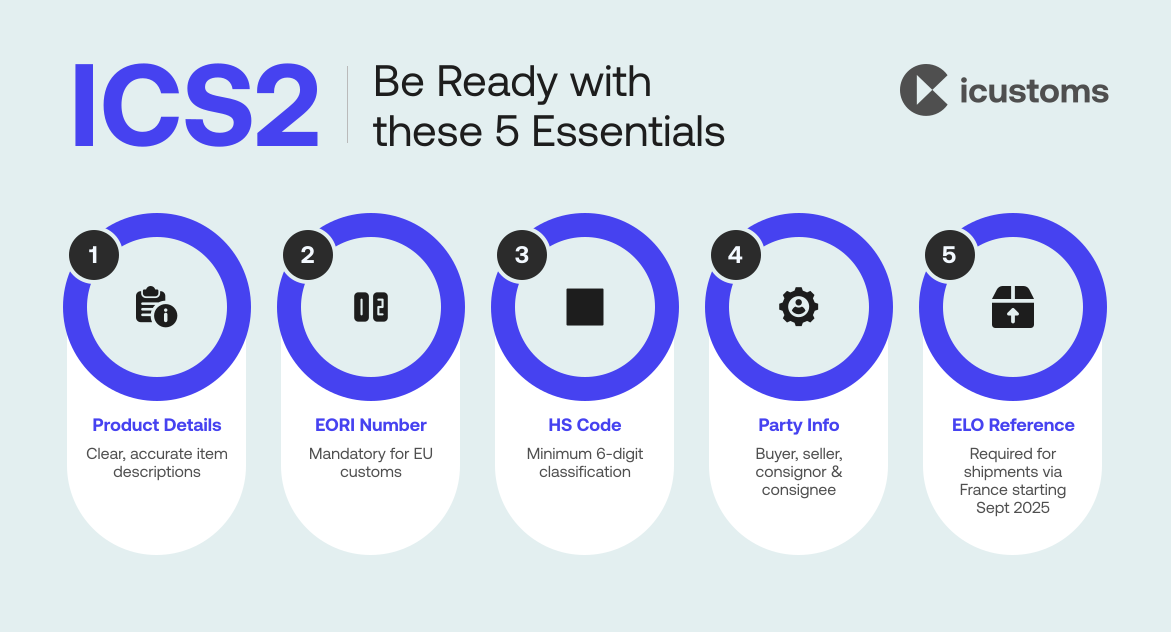
To complete and submit the safety and security declaration to the ICS2, you will need the following information for each product in the shipment:
- Accurate goods description: Each item in the shipment must have an accurate and complete description, including composition, nature, and intended use. Vague or generic descriptions increase the risk of ENS rejections or risk referrals.
- EORI number: It is compulsory to obtain an EORI number from customs authorities of any EU state if your business is involved in customs activities within the EU for ICS2 filings.
- Harmonised System (HS) code: You must provide a minimum of 6-digit HS code for each product to help customs authorities determine taxes & duties, risk analysis and regulatory controls.
- Information on the parties involved: Complete and accurate details of the buyer, seller, consignor, and consignee must be provided as part of the ENS dataset.
- Get your ELO reference: Ensure readiness for the Obligatory Logistics Envelope (ELO), which becomes mandatory by 1 September 2025, for all shipments that pass through the French border. An online service called ELO was created to combine all of the data about the customs and cargo procedures needed to cross the smart border into a single barcode. The goal of this system is to expedite processing times and guarantee safer customs procedures for both import and export flows.
EU Import Requirements Under ICS2: Operational and System Readiness
EU import requirements under ICS2 go beyond data submission and require importers, freight forwarders, and logistics companies to maintain aligned systems and processes. Businesses must adopt a technology-led approach and upgrade IT infrastructure to ensure accurate, secure, and timely safety and security filings. Clear governance of ENS responsibilities is now mandatory for EU-bound trade.
To support these EU import requirements, businesses can use iClassification, an ICS2-ready product classification solution that enables accurate HS codes, standardised goods descriptions, and structured ENS-compliant data.
- ICS2-compatible IT infrastructure
Importers, hauliers, logistics, and shipping companies must reliably connect to ICS2, either directly or via ICS2-compliant software, and support ongoing data validation and transmission. - Keep business processes aligned with ICS2 rules
Internal workflows should reflect current ENS data requirements and timelines, with controls in place to prevent incomplete or late submissions. - Clearly define ENS filing responsibility for EU importers
Businesses must establish whether ENS data is filed by the carrier, freight forwarder, or another party under single or multiple filing arrangements. - Ensure continued system conformance
While deployment windows were part of the rollout phase, businesses should now focus on system stability, data quality, and operational resilience under live ICS2 conditions.
Challenges associated with ICS2
Businesses involved in importing goods to the EU face the following challenges:
Technical and regulatory challenges
As ICS2 has moved into full enforcement, hauliers, road and rail carriers, freight forwarders, courier companies, and customs operators face increasing technical and operational pressure to meet EU safety and security filing requirements.
Technical challenges
ICS2 requires the accurate and timely submission of large volumes of structured shipment data for every movement into or through the EU. For hauliers and courier companies managing high shipment volumes, relying on manual or fragmented processes significantly increases the risk of errors, delays, and rejected filings.
To operate effectively under ICS2, businesses involved in transport and customs operations increasingly depend on reliable IT systems that can automate data capture, validation, and submission while ensuring data security, system availability, and traceability.
Regulatory and operational challenges
Although ICS2 is governed by harmonised EU legislation, compliance is enforced through national customs authorities at the operational level. Hauliers, freight forwarders, and customs brokers must ensure that safety and security data is complete, accurate, and submitted within strict timelines, regardless of the country of entry.
As a result, many transport and logistics operators are moving away from manual, paper-based customs workflows, which are no longer suited to the speed and complexity of cross-border trade. Digitised and system-driven processes are increasingly essential to maintain compliance, reduce border delays, and keep goods moving efficiently across the EU.
EU Import Requirements - Who Exactly is Affected by ICS2?
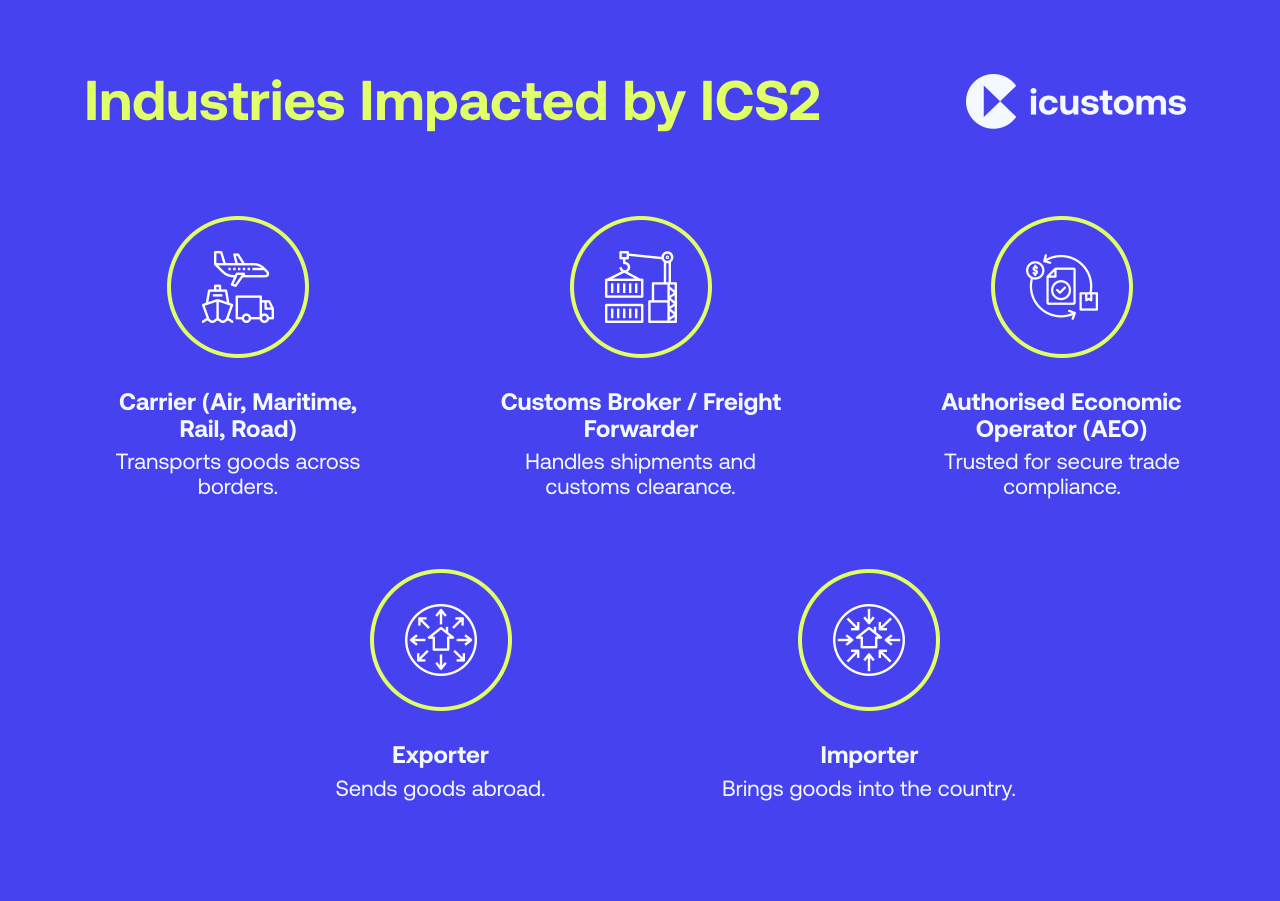
Still wondering if the new EU import requirements won’t affect you? If you’re thinking, “This sounds like a freight forwarder’s problem, not mine,” think again. Anyone shipping goods into or through the EU will feel the impact, as your logistics partners rely on you to provide the accurate, complete information (like 6-digit HS codes and Consignee EORI) for the declarations they file on your behalf.
The most significant change under ICS2 is the shared responsibility for providing accurate safety and security data. This system moves far beyond placing the burden solely on the carrier; it affects every key player in the supply chain.
If your business is involved in moving goods into the EU, you are considered an Economic Operator (EO) and must comply. The requirement to file a complete Entry Summary (ENS) declaration is often distributed among multiple parties in a supply chain, known as multiple filing.
| Type of Economic Operator | Primary Role and ICS2 Relevance |
|---|---|
| Carrier (Air, Maritime, Rail, Road) | The party that physically transports the goods. They hold the ultimate legal responsibility for the transport-level ENS filing. |
| Customs Broker / Freight Forwarder | A specialised agent who handles customs declarations and logistics. They are often the “House-Level Filer” responsible for submitting detailed cargo data. |
| Importer | The party that brings goods into a customs territory (often the consignee). They are legally responsible for the goods upon import and must ensure the required import data is provided. |
| Exporter | The party that sends goods out of a customs territory (often the consignor or seller). They are crucial for providing accurate product information and HS codes for the ENS. |
| Authorized Economic Operator (AEO) | A specially certified, highly trusted trader who enjoys benefits like fewer customs checks and simplified procedures. AEOs still must comply with ICS2 data requirements. |
Is your shipment data strong enough for EU security screening?
Improve ENS data quality and avoid rejections and queries with iCustoms.
Using technology for ICS2 compliance
A strong technological foundation is necessary to meet the demanding requirements of ICS2.
System for data management
To properly gather, store, and send the enormous volume of data needed for ICS2 compliance, businesses must put in place reliable data management systems.
These systems facilitate effective data retrieval and reporting while guaranteeing data security, consistency, and accuracy.
Data exchange platforms
For businesses and customs authorities to communicate seamlessly, it is essential to use safe and effective data exchange platforms.
These platforms make it possible for data to be transmitted electronically, guaranteeing timely submission and lowering the possibility of mistakes during manual data entry.
ICS2 compliance software
Making an investment in specialised ICS2 compliance software, such as the one offered by iCustoms, can greatly expedite the procedure.
This software can create precise ENS declarations, automate data entry, and check data against ICS2 specifications, boosting efficiency.
ICS2 system benefits
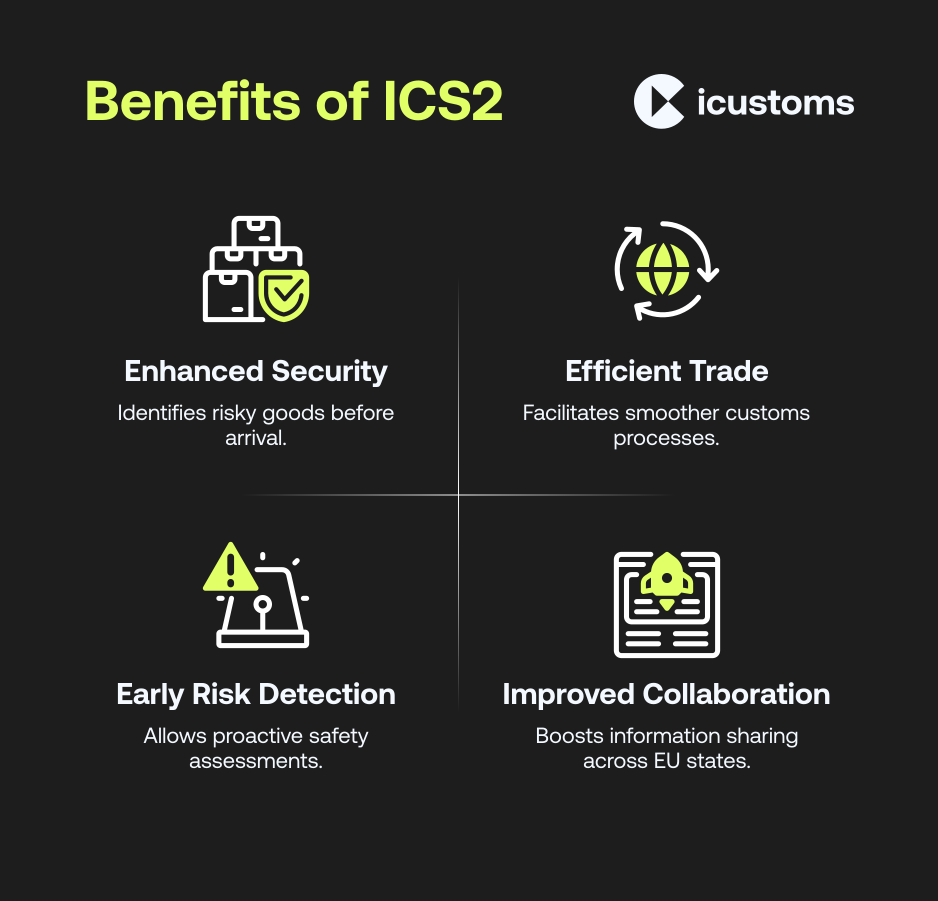
- Improved protection for EU: ICS2 is crucial for protecting the internal market of the European Union, which increases the safety of the customers. This system identifies risky and non-compliant goods by implementing preventative controls.
- Promoting legitimate trade: Thanks to its robust security measures, ICS2 performs effective risk management, facilitating the smooth flow of legitimate trade.
- Early identification of risks: Using advanced risk analysis techniques, the ICS2 enables customs authorities of the EU to detect potential safety issues ahead of time.
- Enhanced cooperation: ICS2 facilitates the rapid exchange of information between various customs authorities, enhancing collaboration between states for effective EU-wide risk analysis.
Applicability of ICS2
Import Control System 2 (ICS2) is applicable for all shipments moving from non-EU countries to EU countries or transiting through EU member states, as well as Northern Ireland, Switzerland, and Norway.
ICS2 Release 3: Operating Under Full Enforcement
Maritime and Inland Waterways House-Level Filers
With ICS2 Release 3 now fully in force, maritime and inland waterways house-level filers, including freight forwarders and consolidators, must operate under a stable enforcement environment where accuracy and timeliness of safety and security data are critical.
To maintain compliance and avoid disruptions, the following practices should be embedded into daily operations:
Assess and maintain system compatibility with ICS2 and ELO requirements, ensuring that IT infrastructure reliably supports ENS data submission and any country-specific obligations.
Collect and verify all required data elements, including goods descriptions, HS codes, and party details, before submitting safety and security declarations.
Ensure operational teams understand ICS2 responsibilities and procedures, particularly where multiple parties are involved in ENS filing.
- Take into account utilising ICS2 compliance software, such as iCS2 by iCustoms, that can automate the tasks associated with safety and security declarations.
Achieve ICS2 Compliance with iCustoms: Your All-in-One Solution
Don’t let the ICS2 Final Countdown create chaos in your logistics operations. iCustoms is a complete, streamlined compliance solution designed to make mandatory EU imports and safety filings simple.
We are committed to helping your business navigate this complex regulation by offering the following critical benefits:
| Feature | Benefit to Your Business | Alignment with ICS2 |
|---|---|---|
| Automated Data Entry | Cut manual work and eliminate errors with AI-powered data extraction from your shipping and commercial documents. | Ensures accuracy and completeness for ENS filings, with full API support for F15 and F50 across both ocean and road shipments. |
| Rapid ICS2 Filing | Submit complete Entry Summary (ENS) declarations in under 2 minutes, avoiding costly border delays. | Guarantees timely submissions required for EU pre-arrival risk analysis. |
| ELO Support | Automatically generate the mandatory Enveloppe Logistique Obligatoire (ELO) forms to meet France’s national requirements. | Supports Member State-specific obligations (like France) during the ICS2 transition. |
| Smart API Integrations | Streamline workflows with API-based contact management, allowing easy reuse of shipper and consignee details for faster filings. | Includes F15 and F50 filing submission directly from the application and provides access to the official ENS EU technical completion matrix documentation for smooth client integration. |
Conclusion:
The European Union’s Import Control System 2 (ICS2) represents a fundamental shift in how supply chain security is managed, embedding risk analysis earlier in the movement of goods entering or transiting the EU. For hauliers, freight forwarders, courier companies, customs operators, and carriers across air, maritime, rail, and road transport, compliance is no longer a transitional exercise but a core operational requirement.
ICS2 is ultimately designed to strengthen security while supporting the smooth flow of legitimate trade. Businesses that adapt by improving data quality, clarifying filing responsibilities, and modernising customs processes are better positioned to reduce delays, respond effectively to customs controls, and maintain continuity across EU borders. In an enforcement-led environment, treating ICS2 as part of everyday operations — rather than a one-time regulatory change — is key to sustaining efficient and secure cross-border trade.

Are your ICS2 processes ready for full enforcement with iCustom?
Automate ENS validation and avoid shipment delays at EU borders.
You may also like:



Simplify Your ENS Submissions with iCustoms

Automate data entry, reduce errors and ensure compliance
Subscribe to our Newsletter
About iCustoms
iCustoms is an all-in-one solution helping businesses automate customs processes more efficiently. With AI-powered and machine-learning capabilities, iCustoms is designed to streamline your all customs procedures in a few minutes, cut additional costs and save time.
Simplify Your ENS Submissions with iCustoms
Automate data entry, reduce errors and ensure compliance