Spain Customs Declaration 2026: ICS2, IOSS, H1 Form and VAT
- John Hall
- Customs Specialist at iCustoms.ai
If you move goods into or out of Spain, a single error in your customs declaration can delay cargo, lead to inspections by customs authorities, or create costly VAT disputes. With ICS2 risk screening, evolving CBAM regulations, and Spain’s transition to the new H1 import form in 2026, compliance is now both digital and data-driven.
Impact of EU Trade Statistics on Customs Declaration Service
In Q4 2025, the EU recorded a €28.4 billion trade surplus, with strong performance in chemicals, machinery and pharmaceuticals. High trade volumes typically lead to tighter customs analytics, especially under ICS2 and post-clearance audit frameworks. For operators filing declarations in Spain, this means greater emphasis on data accuracy, classification integrity and VAT validation rather than procedural formality alone.
As customs systems become more data-centric, the competitive advantage shifts toward structured compliance processes. Operators who combine accurate product classification, automated data validation and integrated filing workflows experience fewer rejections and shorter clearance cycles. In high-volume environments like Spain, efficiency is now driven by data quality rather than manual speed.
This Spain Customs Declaration Guide is written specifically for hauliers, freight forwarders, courier companies, and shipment agents handling B2B and B2C consignments. You will learn how the Spanish Tax Agency, electronic filing systems, tariff classification, VAT, and EU-wide security frameworks fit together in real operational terms.
The Legal Framework behind Spain Customs Regulations
Spain’s customs framework combines EU-wide legislation with nationally administered digital procedures. For freight forwarders and hauliers, understanding where EU law ends and Spanish operational rules begin prevents procedural errors and compliance gaps.
Spain operates under the EU Union Customs Code, but enforcement and digital administration are handled by the Spanish Tax Agency. Understanding this dual structure is essential for trade compliance.
Role of the Spanish Tax Agency (Agencia Tributaria)
The Agencia Tributaria administers import declaration, export controls, VAT collection, and customs enforcement. All customs declarations are submitted electronically through its Electronic Office. For hauliers and shipment companies, this means integration with Spain’s digital DUA and H1 workflows rather than paper-based filing.
How EU Customs Regulations Apply in Spain
Spain applies EU customs regulations including ICS2, NCTS, and CBAM. However, procedural specifics such as VAT accounting, guarantee requirements, and risk profiles are managed nationally. If you already operate in Italy or Germany, expect similarities in structure but procedural differences in portal access and authentication.
Customs Declaration in Spain: DUA to H1 Transition (2026 Update)
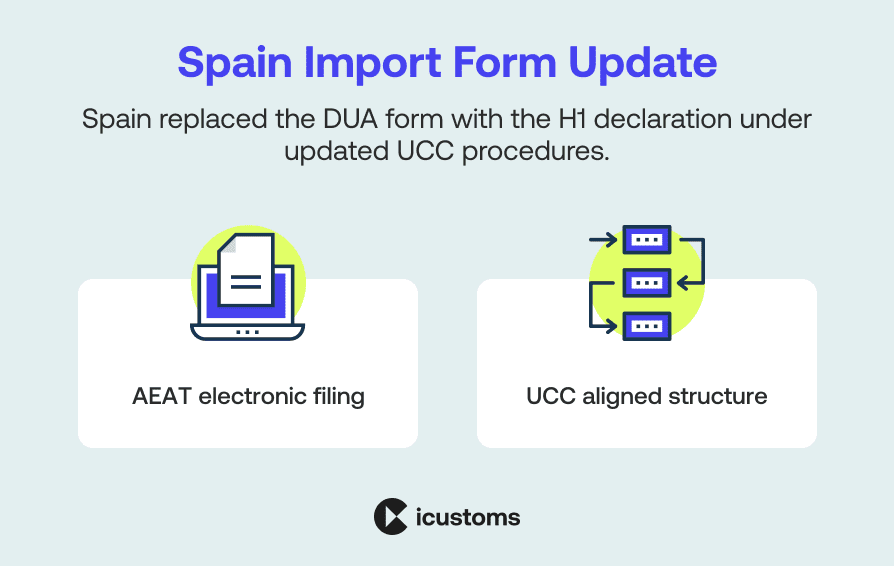
Spain’s import declaration framework continues to evolve in line with the Union Customs Code digitalisation roadmap. Procedural updates such as the transition from DUA to H1 reflect the broader shift toward structured, data-driven customs filing across the EU.
From 18 February 2026, Spain replaced the import form for individuals in the DUA (Single Administrative Document) with the H1 form under UCC-adapted procedures.
What Changed with the H1 Form?
The H1 form replaces the simplified DUA format for goods over €150 declared by individuals. Filing is now accessed via Electronic Office Customs, under Import queries adapted to the Union Customs Code. Freight agents handling B2C shipments must ensure system updates reflect this structural change.
| Element | DUA (Old Version) | H1 Form (2026 Update) |
| Target Users | Individuals and commercial operators | Individuals (goods over €150) |
| Filing Access | AEAT Electronic Office | UCC-adapted Import Queries Portal |
| Data Structure | Traditional SAD format | UCC-aligned structured format |
| Risk | Legacy mapping errors | Field mapping transition risk |
Import Declaration Workflow for B2B Operators
For commercial operators, the customs declaration process still follows structured data submission:
- HS / TARIC commodity code
- Customs value (CIF basis)
- Country of origin
- Import VAT calculation
- Transport details
- Guarantee reference
- Declarant identification
Errors in HS codes or VAT value added tax calculations commonly trigger inspection or post-clearance audits.
Reducing Errors during the H1 Transition
System changes such as the H1 import form increase the risk of incorrect field mapping and incomplete declarations. Automated validation of declaration data before submission helps prevent avoidable rejections. Structured workflows that map invoice data directly into customs declaration fields reduce manual duplication, lower administrative workload and improve consistency across shipments.
How to Submit a Customs Declaration via AEAT in Spain
Filing a customs declaration in Spain requires interaction with the Agencia Tributaria Electronic Office, where import and export declarations are submitted under UCC-aligned digital frameworks. While the process is standardised, operational complexity arises from data structuring, validation requirements, and system dependencies that directly impact customs clearance outcomes.
Step-by-Step AEAT Customs Filing Workflow
For hauliers, freight forwarders, and customs agents, the AEAT filing process typically follows a structured digital sequence:
1. Access AEAT Electronic Office
Operators must enter the Agencia Tributaria Electronic Office portal, where all customs declaration services are hosted. This includes import declarations under H1 and export filings.
2. Authenticate via eIDAS or Cl@ve
Secure login is required using recognised digital identity systems such as eIDAS certificates or Cl@ve Móvil. Without proper authentication, declaration submission is not possible.
3. Select the Relevant Declaration Module
Users must choose the correct declaration type:
- Import declaration (H1 under UCC framework)
- Export declaration
- Transit declaration (NCTS)
Incorrect module selection can lead to rejection or procedural delays.
4. Enter Structured Customs Data
The declaration requires precise data input, including:
- HS or TARIC commodity code
- Customs value (CIF basis)
- Country of origin
- Import VAT calculation
- Transport and consignee details
- Declarant and representation status
Errors at this stage are the primary cause of customs clearance delays.
5. Validate Declaration Data
AEAT systems perform validation checks before submission. Missing fields, incorrect formats, or inconsistent values will trigger system errors.
6. Submit Declaration and Receive MRN
Once validated, the declaration is submitted electronically. A Movement Reference Number (MRN) is issued, confirming successful submission and enabling shipment tracking.
7. Handle Errors, Inspections, or Requests
Customs authorities may:
- Request additional documentation
- Flag inconsistencies under ICS2 risk rules
- Trigger inspection or post-clearance review
Operational response time directly affects customs clearance speed.
VAT in Spain: What Is VAT and How It Applies to Imports
Import VAT in Spain is not merely a tax calculation exercise but a core compliance component of the customs declaration process. Because VAT is assessed on the customs value plus applicable duties and related costs, even small errors in valuation, freight allocation or tariff classification can materially affect the total payable amount.
For hauliers and shipment companies, data accuracy at the declaration stage is essential to avoid reassessments, delays or post-clearance audit exposure. VAT, value added tax, is applied at import based on customs value plus duty and certain ancillary costs.
What Is VAT Value Added Tax in Import Context?
VAT is a consumption tax charged on goods entering free circulation. In Spain, standard VAT is 21 percent, though reduced rates apply to specific goods. Import VAT is calculated on CIF value plus customs duties. Incorrect customs tariff classification directly impacts VAT exposure.
Preventing VAT Miscalculations through Structured Data
Import VAT errors often arise from incorrect freight allocation, missing insurance costs or inconsistent tariff classification. AI-assisted data extraction from invoices improves VAT base accuracy and strengthens internal compliance controls. For freight forwarders managing multiple clients, automated VAT validation reduces reconciliation disputes and protects operating margins.
VAT Number and Deferred VAT Mechanisms
Companies registered in Spain use a VAT number for fiscal identification. Import VAT may be deferred via postponed accounting mechanisms. Freight forwarders should confirm client VAT registration status to avoid liquidity issues during clearance.
IOSS and Low-Value Shipments into Spain
Cross-border e-commerce volumes continue to increase across the EU, making low-value shipment compliance a critical operational priority. For courier operators and freight agents, correct IOSS usage directly affects VAT treatment, clearance speed and customer cost transparency.
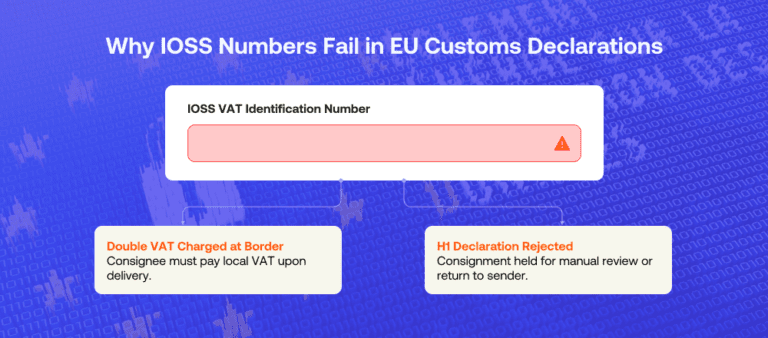
Structured declaration data and accurate IOSS number validation are essential to prevent double taxation, delays or rejection of simplified import procedures. The Import One Stop Shop, IOSS, simplifies VAT for consignments under €150.
How IOSS Works in Spain
Under IOSS, sellers collect VAT at the point of sale and declare it centrally. The IOSS number must be included in customs declaration data fields. Without a valid IOSS VAT registration, shipments risk double taxation or border delays.
IOSS Number Validation and Compliance Risks
Customs verifies the IOSS number electronically. Misuse or incorrect formatting can invalidate simplified treatment. For courier operators handling e-commerce volumes, automated validation within customs filing software reduces compliance errors.
ICS2 and ENS: Security Filing Before Arrival
Pre-arrival security filing is no longer a procedural formality but a data-sensitive compliance requirement across the EU. As trade volumes increase and customs risk engines become more sophisticated, inconsistencies between product descriptions, HS codes and consignee details are more likely to trigger intervention.
For operators moving goods into Spain, early validation and structured data alignment are essential to avoid shipment disruption. The EU Import Control System 2 strengthens risk-based screening.
What Is ICS2 and Import Control System 2?
ICS2 requires pre-arrival security data submission for air, sea, road, and rail. The Entry Summary Declaration, ENS, must be lodged before goods arrive. Data quality is critical, as poor commodity descriptions can trigger “Do Not Load” messages.
ICS2 Filing Practical Considerations
ICS2 filing demands accurate HS harmonized code data and consignee information. Many freight forwarders now integrate ENS submissions directly into logistics systems to prevent duplicate data entry and late submissions.
Improving ENS Data Quality Before Submission
ICS2 screening depends heavily on detailed product descriptions and aligned classification data. Automated consistency checks between commercial invoices, packing lists and ENS filings reduce customs rejections and intervention notices. Early validation prevents shipment holds, improves on-time performance and minimises operational disruption.
NCTS and Transit Procedures in Spain
Transit procedures are central to efficient intra-EU logistics, particularly for goods entering Spain but cleared in another member state. Because duties are suspended during movement, data accuracy and guarantee management become critical control points.
Structured declaration workflows and consistent commodity coding reduce financial exposure, prevent transit rejection and support seamless cross-border movement. Transit movements within the EU use the New Computerised Transit System.
When to Use NCTS in Spain
NCTS applies when goods move under customs control between member states without immediate duty payment. For example, cargo arriving in Valencia destined for France can move under transit until cleared.
Risk Management in Transit Declarations
Guarantee references and accurate commodity codes are essential. Incorrect CN code entries frequently result in guarantee mismatches and administrative penalties.
Streamlining Transit Declarations Across Borders
Transit declarations often require repeated data entry across systems. Integrated customs filing workflows allow reuse of structured commodity, origin and value data across NCTS and import declarations. This reduces administrative workload while maintaining compliance integrity across EU movements and lowering manual processing costs.
Customs Tariff Classification: HS Codes, TARIC and CN Code in Spain
Accurate tariff classification is a fundamental part of submitting a customs declaration in Spain. The commodity code declared determines the applicable customs duty, import VAT calculation, licensing requirements and whether additional measures such as CBAM reporting apply. Because classification directly influences financial liability, errors frequently trigger customs reassessments or post-clearance audits by Spanish customs authorities.
For hauliers, freight forwarders and shipment agents filing declarations through Spain’s electronic customs systems, defensible product classification is essential. Incorrect or inconsistent commodity codes can lead to delays in customs clearance, incorrect duty assessment, or compliance penalties during audit checks.
Understanding HS Codes and Commodity Codes for Spain CDS
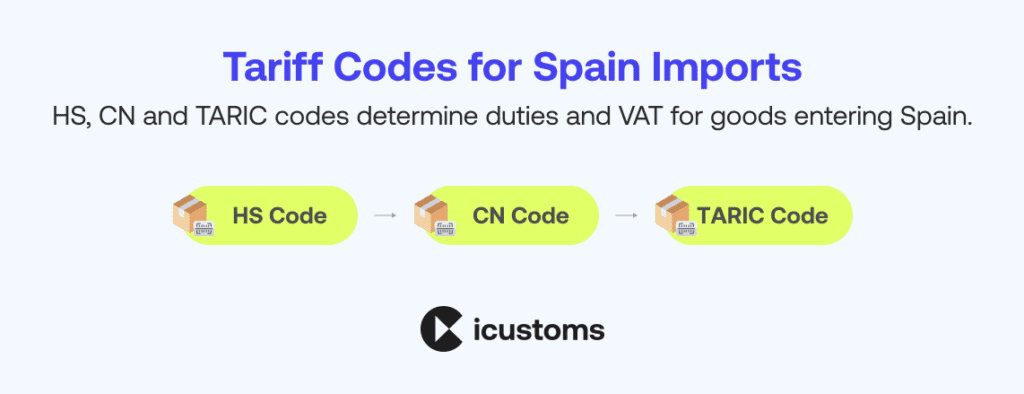
Goods imported into Spain must be declared using the EU tariff classification structure. The Harmonized System (HS) provides the global six-digit product classification framework used worldwide. Within the European Union, this classification is extended through the Combined Nomenclature (CN) and the TARIC customs code, which determine the exact duty rates, trade measures and regulatory requirements applied during customs clearance.
Because Spain applies the EU TARIC database when processing customs declarations, even small classification inaccuracies can affect duty calculations, VAT liability and regulatory controls linked to specific goods categories.
| Code Type | Level | Purpose |
| HS Code | 6-digit international | Global product classification |
| CN Code | 8-digit EU level | EU statistical & tariff control |
| TARIC Code | 10-digit EU Level | Duty rates, restrictions, trade measures |
Finding the Right Commodity Codes Faster for Spain Customs Declaration
For Spain customs declaration, identifying the correct HS code or TARIC customs code manually can be time-consuming, particularly for electronics, chemicals and multi-component goods. AI-supported product classification tools compare structured product descriptions against tariff databases to suggest accurate commodity codes. This approach reduces classification disputes, improves declaration speed and strengthens audit defensibility.
How to Find HS and Commodity Codes Using ECICS
Chemical goods require consultation of the European Customs Inventory of Chemical Substances. Using ECICS Information ensures correct classification and regulatory compliance. Freight agents handling electronics should also verify HS code electronic variations carefully.
CBAM Regulations and Environmental Reporting in Spain
Certain imports into Spain may fall under the EU Carbon Border Adjustment Mechanism (CBAM), which requires importers to report the embedded emissions of specific carbon-intensive goods. Although CBAM is primarily an environmental regulation, it is closely connected to customs declarations because the applicable commodity code determines whether a shipment falls within CBAM scope.
For freight forwarders and shipment agents submitting declarations through Spain’s customs systems, correct HS or TARIC classification and accurate customs value reporting are essential for identifying potential CBAM obligations. Early verification during the declaration preparation stage helps importers avoid compliance gaps, reporting errors, or delays linked to CBAM regulatory checks.
What Are Spain CBAM Regulations?
CBAM applies to carbon-intensive goods such as steel, cement, and aluminium. Spain based importers must declare embedded emissions and submit quarterly reports. Incorrect commodity codes may cause failure to identify CBAM-liable goods.
Linking Commodity Codes to Environmental Reporting
CBAM reporting relies on precise tariff classification and customs value alignment. Automated cross-checking between HS codes and carbon reporting obligations helps identify exposure early in the declaration process. This proactive approach reduces reporting stress, strengthens compliance governance and avoids retroactive correction filings.
Operational Impact for Freight Forwarders
Forwarders are increasingly asked to support clients with CBAM data collection. Early identification of affected goods reduces reporting stress and avoids penalties.
eIDAS Regulation and Digital Authentication
Secure digital identity is central to Spain’s customs systems.
eIDAS Regulation and Digital Authentication
Secure digital identity is central to Spain’s customs systems.
eIDAS Regulation and Cross-Border Authentication
The eIDAS Regulation standardises electronic identification across the EU. It enables trusted digital signatures and cross-border system access.
What Is Cl@ve Móvil?
Cl@ve Móvil is Spain’s electronic access system for public services. Users authenticate via QR code scanning or SMS PIN confirmation. Freight agents filing on behalf of clients must ensure registration in the Cl@ve system to access AEAT services.
Intelligent Document Processing in Customs Filing
As customs declarations become more data-intensive under EU digital frameworks, the quality and structure of submitted information directly influence clearance speed and audit outcomes. Manual transcription of invoices and supporting documents increases the likelihood of inconsistencies between classification, valuation and security filings.
Structured digital extraction and validation processes are therefore becoming a foundational element of modern trade compliance operations. Manual data entry increases error risk in customs declaration service operations.
How Intelligent Document Processing Reduces Risk for Spain Customs
Intelligent document processing extracts invoice data, commodity descriptions, and values automatically, making Spain customs smooth and error free. This reduces HS code misclassification and VAT miscalculation. By transforming unstructured invoices into structured customs data fields, operators reduce manual entry errors and classification inconsistencies. In high-volume freight environments, automation significantly lowers operational cost per declaration while improving submission speed and data accuracy across EU customs systems.
Automation and Customs Filing Software
Modern customs filing software integrates tariff databases, ICS2 filing modules, and VAT calculation engines. Automation supports consistent compliance across multiple EU countries.
ENS, Data Quality and Trade Compliance Audits
Customs authorities increasingly rely on analytics to identify risk patterns across shipments. Data quality is no longer a compliance checkbox, it directly influences inspection decisions. Poor or inconsistent data increases the likelihood of delays, flags, and deeper scrutiny.
Entry Summary Declaration Data Integrity
ENS submissions must include accurate shipper, consignee, and goods description details. Generic descriptions like “electronics parts” often trigger inspections.
Preparing for Post-Clearance Audits
Trade compliance audits review customs value, TARIC usage, and origin claims. Maintaining digital records aligned with declaration data ensures defensibility during review.
Real-World Example: Electronics Shipment into Barcelona
A Singapore-based exporter ships consumer electronics into Barcelona valued at €200,000. The freight forwarder:
- Files ENS under ICS2.
- Submits import declaration with correct HS code TARIC classification.
- Calculates VAT at 21 percent.
- Confirms no CBAM applicability.
- Uses postponed VAT accounting via client VAT number.
A single HS code error could alter duty rate and VAT base, increasing liability significantly.
Building Scalable Customs Operations in Spain
For freight forwarders and shipment agents managing increasing trade volumes, customs efficiency depends on repeatable and structured processes. AI-assisted classification, automated VAT calculation and integrated ICS2 filing create measurable operational gains. Faster declaration cycles, lower rejection rates and improved audit readiness translate directly into competitive advantage. Structured compliance does not replace professional expertise. It enhances it by removing repetitive manual tasks and reinforcing internal trade compliance controls.
Conclusion: Building Resilient Spain Trade Compliance in 2026
Spain customs operations are now fully digital, security-driven, and data-sensitive. Between ICS2 screening, CBAM reporting, IOSS validation, VAT accuracy, and the 2026 H1 transition, forwarders must treat customs declaration as a strategic compliance function rather than administrative paperwork.
To summarise:
- Accurate HS and TARIC classification protects margin.
- ICS2 and ENS data quality prevent shipment delays.
- VAT structuring improves cash flow.
- CBAM compliance avoids regulatory penalties.
- Digital authentication via eIDAS and Cl@ve Móvil is mandatory.
For logistics operators managing multi-country EU flows, integrated automation is no longer optional. Platforms like icustoms.ai support intelligent document processing, automated classification, ICS2 filing, and EU-wide customs orchestration from a single interface.
As EU trade flows expand and enforcement becomes increasingly data-driven, operators who invest in structured customs processes position themselves ahead of regulatory complexity. Intelligent classification tools, automated validation workflows and integrated EU filing systems are becoming standard components of modern trade compliance infrastructure.
If you want to reduce clearance time, minimise compliance risk, and scale Spain trade operations confidently, explore how structured digital customs infrastructure can support your next shipment.
FAQ: Spain Customs Declaration Guide
Who submits a customs declaration in Spain?
The importer of record or their appointed customs representative submits the declaration through the Spanish Tax Agency’s Electronic Office.
How do HS codes and TARIC codes apply to customs declarations in Spain?
HS code is a six-digit international classification used globally. In Spain, customs declarations require the TARIC code, which extends HS classification with EU-specific duties, measures, and restrictions enforced by Spanish customs authorities.
Is ICS2 ENS filing mandatory for goods entering Spain?
Yes. ICS2 applies to all goods entering Spain as part of the EU. Entry Summary Declarations must be submitted in advance, with timing depending on the transport mode and point of entry into Spanish territory.
When is IOSS required for imports into Spain?
IOSS applies to consignments under €150 sold to consumers in Spain. The IOSS number must be included in customs data to ensure VAT is collected at the point of sale and avoid additional charges at import.
How is import VAT calculated by Spanish customs authorities?
In Spain, import VAT is calculated on the customs value of goods, including duties and certain additional costs such as transport and insurance. The standard VAT rate is 21 percent, with reduced rates applied to specific goods.
What is the H1 import declaration and how does it apply in Spain?
From February 2026, individuals importing goods into Spain valued over €150 must use the H1 import declaration. This replaces the previous DUA-based process for certain use cases and aligns with updated EU customs procedures.
How is Cl@ve Móvil used for Spanish customs and tax access?
Cl@ve Móvil is used in Spain to securely access the Agencia Tributaria Electronic Office. It enables authentication for customs declarations, tax filings, and related procedures using QR codes or SMS-based verification.

Spain Customs Declarations, Simplified with AI
Automate ICS2, IOSS, VAT, and H1 filing with accurate data, faster processing, and fewer errors
You may also like:

How TARIC Codes Influence Import Duties
Struggling to Extract, Catagorise & Validate Your Documents?

Capture & Upload Data in Seconds with AI & Machine Learning
Subscribe to our Newsletter
About iCustoms
iCustoms is an all-in-one solution helping businesses automate customs processes more efficiently. With AI-powered and machine-learning capabilities, iCustoms is designed to streamline your all customs procedures in a few minutes, cut additional costs and save time.
Struggling to Extract, Catagorise & Validate Your Documents?
Capture & Upload Data in Seconds with AI & Machine Learning