
Master UAE Customs: A Complete MPCI Guide
- John Hall
- Customs Specialist at iCustoms.ai
Did you know that incorrect customs clearance documentation can delay your shipments by up to 14 days?
Imagine a shipment of high-value electronics, destined for Dubai, sitting idle at Jebel Ali Port. Not due to weather or logistics, but because of a single, costly error in a customs declaration. The result? A staggering UED 50,000 loss in fines, demurrage, and missed global market opportunities. This isn’t a rare nightmare; it’s a preventable reality for traders who overlook a critical component of modern shipping.
For businesses that transport cargo via one of the world’s largest trading platforms, such delays result in significant expenses and logistical inconveniences. The Maritime Preload Cargo Information (MPCI) system, implemented by the UAE, is crucial to streamlining this process. Nonetheless, its requirements and adequate implementation conflict with many shippers.
Whether you’re a shipping line, freight forwarder, or importer, understanding MPCI requirements has become crucial for successful customs clearance in the United Arab Emirates. This practical MPCI Guide will walk you through the entire process—from registration and filing deadlines to data requirements and common pitfalls.
By learning these processes, you will not only save time and money that would be wasted due to delays and penalties, but you will also have an advantage over your competitors in this important trade gateway. We will explore all there is to know with regard to manoeuvring through the United Arab Emirates customs requirements.
Understanding MPCI and Its Role in UAE Customs
The UAE maritime shipping landscape is undergoing significant change with the implementation of the Maritime Preload Cargo Information (MPCI) system. Understanding this new requirement is essential for anyone involved in the Arab Emirates customs clearance processes.
What is (MPCI)?
Maritime Preload Cargo Information (MPCI) represents an advanced manifest filing system designed specifically to enhance maritime security across United Arab Emirates ports. The system requires detailed cargo information to be submitted electronically to the UAE authorities before the vessel is loaded at its port of origin. In essence, MPCI creates a pre-screening mechanism that allows officials to assess potential risks and identify security threats before shipments reach UAE waters.
Managed by the National Advanced Information Centre (NAIC), which operates under the Federal Authority of Identity, Citizenship, Customs, and Ports Security (ICP), MPCI focuses exclusively on containerised cargo. Furthermore, the programme applies to all containerised maritime shipments bound for UAE ports—whether for import, transshipment, transit, or Freight Remaining on Board (FROB).
The MPCI programme starts on 31 July 2025, although authorities have allowed a grace period extending until 31 March 2026, during which no penalties will apply.
How MPCI supports customs clearance
Although separate from customs filing processes, MPCI significantly enhances UAE customs clearance in several ways. By requiring electronic submission 24 hours before vessel loading at the last foreign port, the system allows for advanced security screening that consequently expedites cargo processing upon arrival.
Once a filing is submitted, the NAIC responds with one of three status codes:
- ACT (Accepted): Cargo is approved to proceed with loading
- DNL (Do Not Load): Loading is not permitted
- RFI (Request for Information): Additional information is required before approval
This proactive approach enables authorities to identify potential issues early in the shipping process rather than dealing with problems after cargo arrives in the UAE. Additionally, by standardising data submission through the EDIFACT CUSCAR 23A format, MPCI creates uniformity that streamlines processing.
The Executive Director of NAIC emphasised that “by ensuring cargo information is assessed before departure, we enhance national security, streamline Customs processes, and facilitate smoother trade flows.” Subsequently, these improvements help goods move through UAE ports with greater predictability and control, ultimately benefiting all parties involved in the supply chain.
Who Must File MPCI documentation and When
Understanding exactly who needs to file MPCI documentation is crucial for seamless cargo movement through UAE ports. The new requirements establish clear responsibilities and timelines that directly impact UAE customs clearance processes.
Shipping lines, freight forwarders, and NVOCCs
The MPCI programme mandates electronic submission from all key players in the maritime shipping chain. Three primary entities bear filing responsibilities:
- Shipping Lines: Must file either Direct Bills of Lading for non-consolidated shipments or Master Bills of Lading for consolidated shipments
- Freight Forwarders: Responsible for filing House Bills of Lading for consolidated shipments they manage
- NVOCCs (Non-Vessel Operating Common Carriers): Must submit House Bills of Lading for their consolidated cargo
Importantly, shipping lines should not file the House B/L—this remains the responsibility of freight forwarders and NVOCCs exclusively. Moreover, every entity issuing a House Bill of Lading must collaborate with a registered agent in the UAE who assumes liability for the filing’s accuracy and timeliness.
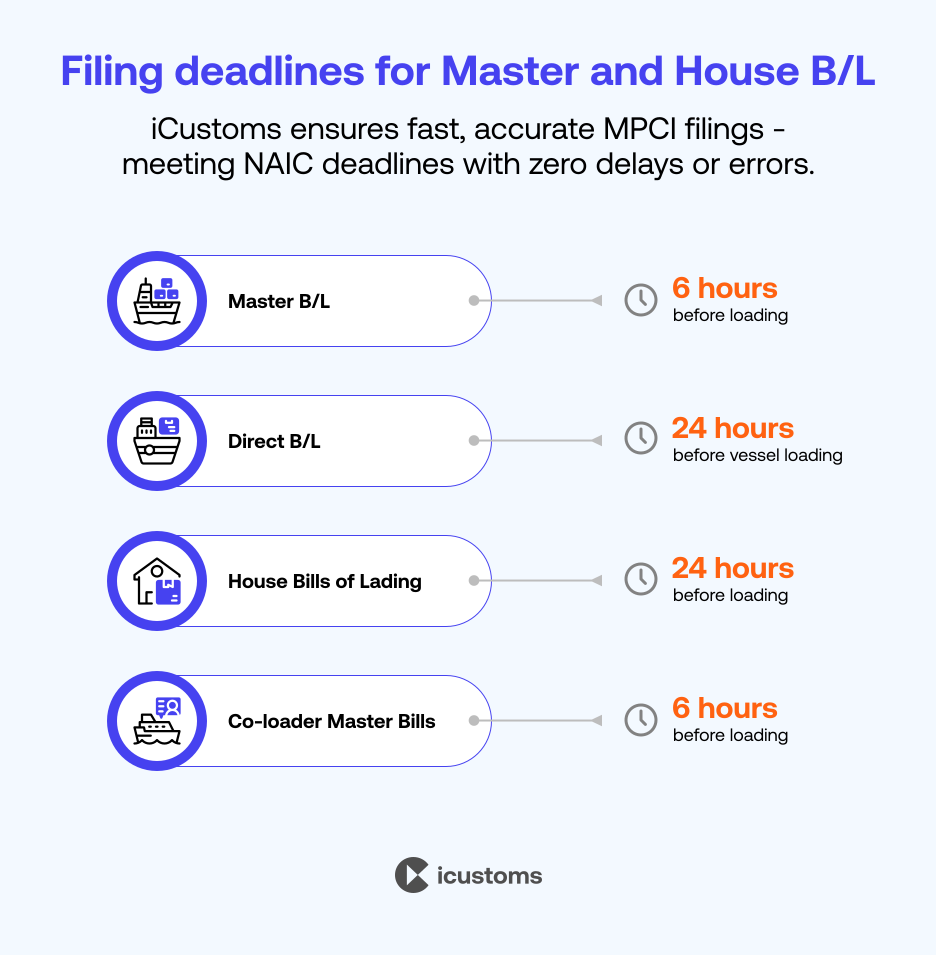
Filing deadlines for Master and House B/L
Timeliness is essential within the MPCI framework. The official NAIC guidelines establish precise submission deadlines based on document type:
- Master Bills of Lading: Must be filed at least 6 hours before vessel loading commences
- Direct Bills of Lading: Require submission at least 24 hours before vessel loading
- House Bills of Lading: Must be filed a minimum of 24 hours before loading begins
- Co-loader Master Bills: Require filing at least 6 hours before loading
Whilst these represent the regulatory cut-offs, carriers typically establish earlier working deadlines—often 72 hours before estimated time of departure—to ensure proper processing. Missing these carrier deadlines frequently means missing the sailing altogether.
Cargo types that require MPCI
The programme encompasses several cargo movements through the UAE maritime gateways:
- Import shipments: All containerised cargo bound for final delivery in the UAE
- Transit shipments: Cargo moving through UAE ports to other destinations
- Transshipment cargo: Containers transferring between vessels at UAE ports
- FROB (Freight Remaining on Board): Cargo staying aboard vessels while in UAE ports
This applies exclusively to containerised maritime cargo, including both full container loads (FCL) and less than container loads (LCL).
Exemptions and special cases
Nevertheless, certain shipments fall outside MPCI requirements:
- Export shipments: Cargo leaving the UAE is exempt.
- Non-containerised maritime cargo: Including breakbulk, liquid bulk, and Ro-Ro shipments
- Wooden vessels: Excluded from the current implementation phase
- Empty containers: Unless they’re shipper-owned containers with residue
- Crew’s effects: Personal belongings of vessel crews
The MPCI programme officially begins in July 2025, yet authorities have wisely implemented a grace period extending until 31st March 2026. Throughout this transitional period, no penalties or enforcement actions will apply, allowing stakeholders sufficient time to adapt their processes.
MPCI Filing Required Data & Registration Steps
The success of UAE customs clearance, according to the new MPCI system, depends on preparation. After knowing who should submit and when to submit, the next most important step you will need is to collect the right data. We will take a closer look at what exactly you will need to have a successful MPCI filing.
MPCI Party ID and registration
The MPCI Party ID serves as your unique identifier in the system—essentially your digital passport for United Arab Emirates customs clearance. This distinctive code is assigned by the National Advanced Information Centre (NAIC) to each registered entity. Without this ID, you simply cannot proceed with filing.
To obtain your MPCI Party ID:
- Register on the NAIC portal as the first essential step
- Complete the registration process specific to your role (shipping line, freight forwarder, or NVOCC).
- Wait for confirmation and receipt of your unique identifier.
Essentially, every party, such as shipping lines, freight forwarders, NVOCCs, and shipping agents, has to ensure that they are registered by NAIC before making any filings. This is needed whether you are high up the supply chain or not.
Required shipment and cargo data
Successful filing demands comprehensive data primarily found on Bills of Lading, plus several additional elements. The system requires:
- Bill information: Bill number, issue date, and location
- Party information: Complete names and addresses for shipper, consignee, and notifying party (P.O. Boxes are not acceptable)
- Port details: Loading, discharge, transshipment, receipt, and delivery ports
- Cargo specifics: Clear description of goods, 6-digit Harmonised System (HS) code for each commodity, package count and type, gross weight
- Container information: Container numbers and all seal numbers
Indeed, freight forwarders must include MPCI identifiers for the master co-loader or shipping line, whilst shipping lines must include identifiers for any consolidating (child) freight forwarders in consolidation cases.
Vessel and voyage details
For shipping lines specifically, vessel and voyage information is mandatory. This includes:
- Details about the vessel’s journey
- Last foreign port of call before UAE arrival
- Port of loading specifics
- Port of discharge information
- Estimated time of departure and arrival
Throughout the submission process, relationships between parties must be clearly established through proper identification. Shipping lines and freight forwarders must provide their own MPCI Party IDs, and additionally, freight forwarders need to include identifiers for the master co-loader or shipping line.

Common Data Errors in MPCI Filing (and How to Avoid Them)
Even minor mistakes can trigger Requests for Information (RFIs) or outright rejections, delaying your UAE customs clearance. The most frequent filing errors include:
- Missing or inconsistent data: discrepancies between Master BL and House BL information, wrong party names, or HS codes that don’t match cargo descriptions are the primary reasons for RFIs.
- Incorrect movement types: Filing under the wrong movement type or using incorrect port/terminal codes leads to immediate rejections.
- Technical validation failures: Small errors in container numbers, seal numbers, or HS codes often pass visual checks but fail machine validation at NAIC.
To minimise these errors:
- Use a single source of truth for BL data to avoid manual retyping errors.
- Validate all mandatory fields and ensure data consistency
- Align cargo descriptions with corresponding HS codes
- Implement a review process before final submission
Remember that after filing, NAIC will respond with one of three status codes: ACT (Accepted), DNL (Do Not Load), or RFI (Request for Information). Your goal is always to receive ACT status without intervention, which requires meticulous attention to the details outlined above.
Step-by-Step MPCI Filing Process
Navigating the MPCI filing process requires methodical steps for successful UAE customs clearance. With careful preparation, you can streamline the entire procedure and avoid unnecessary delays.
1. Apply for your MPCI ID.
The journey begins with registration on the National Advance Information Centre (NAIC) portal. This initial step is mandatory for all filing parties—whether you’re a shipping line, freight forwarder, or NVOCC. After completing the application process, you’ll receive a unique MPCI Party ID that serves as your digital identifier within the system. This ID must be included in all your future submissions and is non-transferable.
2. Choose a filing platform or provider.
Once registered, you must decide how you’ll submit your declarations. Two primary options exist:
- Direct filing via NAIC’s web portal (manual data entry)
- Using a certified Technology Service Provider (TSP)
For freight forwarders, working with a TSP often proves more efficient. These providers offer integrated electronic data interchange (EDI) solutions that significantly streamline the process. Many TSPs provide additional services such as automated validation, real-time status updates, and error-handling assistance.
3. Upload and validate shipment data
Now, prepare your shipment information carefully. Upload your bill of lading details alongside all required shipment data. Most platforms offer both single-entry and bulk upload options, depending on your volume needs.
First-class platforms typically include pre-submission validation tools that check for:
- Mandatory field completion
- Data format correctness
- Pattern validation for containers and HS codes
- Consistency between related fields
4. Submit to NAIC and track responses
After validation, electronically transmit your filing to NAIC through your chosen platform. The system processes your submission and returns one of three responses: Assessment Complete (ACT), Do Not Load (DNL), or Request for Information (RFI).
Currently, most platforms like iCustom provide real-time tracking dashboards where you can monitor filing status updates. Shipping lines or master co-loaders can even view high-level filing assessment statuses of their sub-co-loaders or consolidating freight forwarders.
5. Handle RFIs and resubmit if needed
In case you receive an RFI, prompt action is crucial. You must provide the requested information or update your filing within the specified timeframe. Typically, this involves either:
- Submit an updated version of your message with additional details.
- Providing the required supporting documents through the attachment service
Importantly, if you fail to respond to an RFI within the allocated time, your filing will expire, necessitating a complete resubmission. Hence, assigning clear ownership for post-submission monitoring proves essential for smooth UAE customs clearance.
Avoiding Delays and Penalties
Failing to comply with MPCI requirements carries serious implications for shipping stakeholders. Non-compliance directly affects your UAE customs clearance process and bottom line.
Consequences of late or incorrect filing
Financial penalties await those who submit late filings or provide incorrect data. Even more concerning, carriers will likely issue “Do Not Load” directives for non-compliant cargo, disrupting your supply chain before it even leaves the origin port. Shipments arriving without proper MPCI clearance face potential detention by customs authorities, creating substantial delays and extra costs. Repeated violations could trigger further enforcement actions against your company.
How iCustom Can Help in Your MPCI Compliance
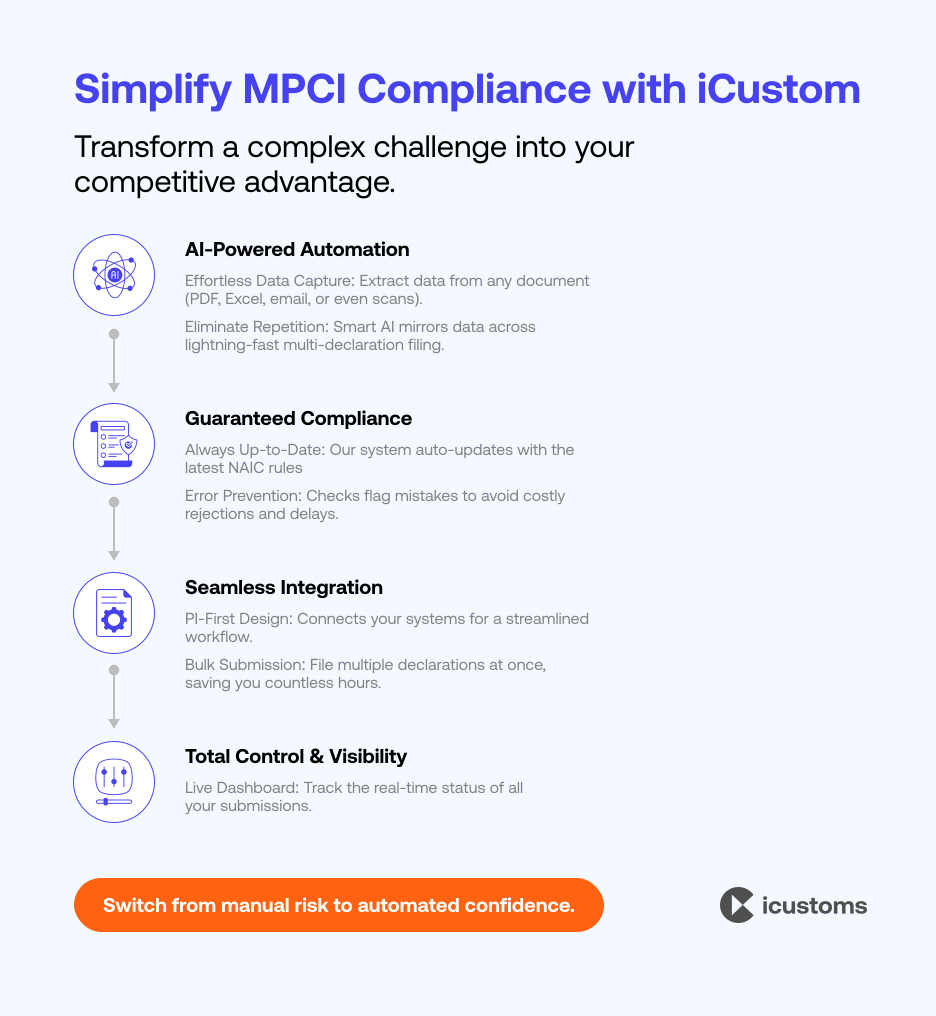
Managing MPCI submissions manually is a high-risk, time-consuming endeavour. This is where iCustom transforms your compliance from a challenge into a competitive advantage.
iCustom is an intelligent trade facilitation platform designed to streamline the entire MPCI process. Its powerful features eliminate human error and save valuable time:
1. AI-Powered Data Automation (IDP)
- IDP for Document Processing: Provides flexible intake methods, allowing you to submit documents via email, API integration, or simply bulk upload using drag-and-drop.
- Universal Format Acceptance: The system processes documents in any format, including PDF, CSV, Excel (XLS/XLSX), Google Sheets, and even scanned images (PNG/JPEG).
- Data Mirroring: Advanced AI eliminates repetitive entries by extracting, verifying, and mirroring data across documents, enabling you to submit multiple declarations in a flash.
- Core Function: Extracts, validates, and auto-populates all necessary MPCI fields (Shipper, Consignee, HS Codes, etc.) with up to 99.9% accuracy.
2. Guaranteed Robust Compliance
- Regulatory Agility: Our unique built-in feature automatically updates with the latest NAIC regulations, keeping you compliant at all times without requiring manual tracking.
- Pre-Submission Error Checking: Flags discrepancies and missing data before you submit to the authorities, preventing costly rejections and Request for Information (RFI) responses.
3. Seamless System Integration (API-First)
- Full API Capability: iSecurity is built with full API capability, allowing it to plug directly into your existing IT systems for smooth, automated data exchange.
- Friction-Free Workflow: Save countless hours, ditch repetitive work, and maintain a seamless, efficient workflow from document creation to customs submission.
4. Workflow Efficiency and Speed
- Speed through Filings: Speed through your international cargo security pre-arrival filings with a customs-approved solution, turning a 30-minute task into a filing completed in seconds.
- Bulk Submission: The system supports the batch submission of multiple declarations, drastically reducing the processing time per shipment.
5. Real-Time Tracking and Control
- Real-Time Monitoring: Access an intuitive dashboard to monitor the live status of all your MPCI submissions (ACT, RFI, DNL), providing 360-degree visibility.
- Informed Decisions: Get instant feedback from NAIC, enabling you to act immediately on RFI responses and maintain complete control over your cargo flow.
Businesses using iCustom report a 50% reduction in customs-related delays and a significant decrease in compliance-related costs, allowing their teams to focus on strategic growth rather than administrative paperwork. For more information, you can visit the website as well.
Conclusion
The process of clearance of goods at the customs of UAE definitely needs a lot of preparation and attention to detail. The implementation of the Maritime Preload Cargo Information System is a major change in the movement of cargo within the UAE ports. We have covered all the key elements of MPCI compliance, including registration and filing deadlines and data requirements, among others, throughout this guide.
To start with, it is important to keep in mind that the process of compliance starts with acquiring your own MPCI Party ID. This identification is your digital passport in the system, which is obligatory for every member of the supply chain. Further, it is important to know your particular filing duties depending on your position: shipping line, freight forwarder, or NVOCC, to be able to clear customs successfully.
The grace period till March 31, 2026, is a precious time to change your processes. However, being well prepared makes you competitive. Effective paperwork, correct categorisation, and careful data verification shall become your best friends in a smooth UAE customs clearance.
And, once you have mastery of MPCI requirements, it is not only that you avoid delays and penalties, but this also places your business in a position to succeed in one of the most strategic trade gateways in the world today. Following the tips in this guide, you will be able to turn the logistical challenges that may emerge into efficient operations to benefit your overall business goals. Most of the sites, like iCustom, provide real-time tracking dashboards that enable you to monitor updates in file status.
Frequently Asked Questions
Is NAIC MPCI filing related to customs filing?
Yes, NAIC–MPCI is a mandatory electronic pre-arrival customs filing system for cargo entering the UAE.
What is the difference between the MPCI and PLACI programmes?
MPCI is the UAE system, while PLACI (Pre-Load Advance Cargo Information) is a similar EU programme.
When does the MPCI programme go into effect?
The MPCI programme is currently in effect and mandatory for sea freight shipments arriving in the UAE.
I am an economic operator looking for information on the filing process and requirements. Where can I find this information?
Information can be found on the official UAE Customs websites (e.g., Dubai Customs, Abu Dhabi Customs) and within the MPCI portal.
Do the filing deadlines apply to updates as well?
Yes, amendments or updates should be submitted and accepted before the vessel's arrival to avoid penalties.
How should filings be submitted to NAIC?
Filings must be submitted electronically via the designated MPCI online platform or interface.
Are there specific data format requirements for submissions?
Yes, submissions usually require documents in specific approved formats like PDF or XML.
Can an RFI be answered via email?
Generally, no; RFI responses must be submitted through the official MPCI platform for tracking and compliance.
You may also like:
Struggling to Extract, Catagorise & Validate Your Documents?

Capture & Upload Data in Seconds with AI & Machine Learning
Subscribe to our Newsletter
About iCustoms
iCustoms is an all-in-one solution helping businesses automate customs processes more efficiently. With AI-powered and machine-learning capabilities, iCustoms is designed to streamline your all customs procedures in a few minutes, cut additional costs and save time.
Struggling to Extract, Catagorise & Validate Your Documents?
Capture & Upload Data in Seconds with AI & Machine Learning