Germany Customs Guide: Operational and Trade Compliance for Logistics Operators
- John Hall
- Customs Specialist at iCustoms.ai
Germany remains one of the most important hubs of international trade in Europe and globally, reflecting its massive logistics throughput and strategic position in supply chains. In 2024, Germany recorded exports of goods and services valued at approximately $1.55 trillion, with total imports exceeding $1.31 trillion. According to Eurostat, Germany accounted for approximately 27.4% of the EU’s extra-EU exports and 18.6% of extra-EU imports, significantly outpacing other Member States.
These figures are not just economic indicators, they represent system pressure. Every declaration submitted into Germany’s customs environment enters one of the most heavily utilised digital customs infrastructures in the EU. High volume means low tolerance for error.
High Volume, High Stakes: Operational Consequences of Customs Delays
In Germany, customs procedures are not administrative formalities completed after transport is arranged. They are operational gatekeepers. A delayed customs release does not merely slow administrative processing; it can cause missed terminal slots, vehicle rescheduling, warehouse congestion, and contractual penalties.
Rejection Risk at Scale in High-Volume Environments
For logistics operators, customs errors due to manual filing scale with volume. A single misclassification of product or incomplete data element in ATLAS may result in customs rejection. When multiplied across hundreds of consignments, this becomes a systemic operational inefficiency rather than an isolated issue.
Quantifying the Cost of ATLAS Rejection Cycles for Germany Customs
Even a low customs rejection rate becomes operationally material at scale. For example, a 2% rejection rate across 2,000 monthly import filings results in 40 re-declarations. Each correction via the ATLAS Germany customs may require data review, revalidation, and coordination with brokers or carriers, often while goods remain uncleared. The cumulative labour, storage, and scheduling impact can quickly outweigh the perceived efficiency of manual customs declaration processes.
Germany’s customs environment therefore combines two characteristics:
- Enormous trade flow
- Highly structured digital enforcement
Freight forwarders must treat customs compliance as a core operational discipline rather than a regulatory afterthought.
Role of Zoll in Germany’s Customs Enforcement Framework
The national customs authority in Germany is Zoll. It enforces EU and national trade, revenue, and security regulations and administers import, export, transit, tariff classification, valuation, and post-clearance controls.
Zoll’s enforcement model is increasingly data-driven. Decisions on release, inspection, or referral are influenced by structured electronic submissions and automated risk analysis rather than discretionary manual review.
This means accuracy is evaluated algorithmically before goods move physically.
Industry statements made during International Customs Day 2025 highlighted the need for interoperable IT systems and digital alignment between trade and enforcement authorities. This underscores a key reality: German customs is not simply rule-based, it is infrastructure-based.
Import Customs Declaration Process in Germany
The import customs declarations process in Germany must be submitted electronically through ATLAS. Goods cannot be released into free circulation without a successfully validated submission.
The e customs declaration not only determines the import fees in Germany but also:
- Import tariff treatment
- Duty and Import VAT calculation
- Eligibility for special procedures
- Inspection probability
An import filing is therefore both a fiscal event and a risk-scoring event.
ATLAS Zoll System & Operator Obligations
ATLAS (Automated Tariff and Local Customs Software) is Germany’s national customs IT platform. It enforces structured data requirements across import and export declarations.
Key elements include:
- HS code (6-digit minimum international level)
- EU Combined Nomenclature (8-digit)
- German TARIC/Zolltarifnummer (10–11 digit precision)
- Customs value
- Origin
- EORI identifiers
- Procedure codes
It is important to understand that while the 6-digit HS code provides global classification, the extended German Zolltarifnummer determines precise tariff measures, anti-dumping applicability, and trade policy controls. Errors at the 10th or 11th digit level can materially change duty outcomes.
ATLAS Validation Controls and Rejection Cycles
ATLAS validates data before a clearance decision is issued. If inconsistencies are detected, for example, between commodity code and declared measure, the system generates a rejection. The declaration must then be corrected and resubmitted.
In operational terms:
An incorrect extended tariff digit
→ ATLAS rejection
→ Amendment cycle
→ Goods remain uncleared
→ Terminal storage costs begin accumulating
→ Delivery schedule impacted
Operators relying on manual spreadsheets for customs declarations experience this cycle more frequently, especially under high-volume conditions.
Export Customs Declaration Process in Germany
Exports must be declared before goods leave the EU customs territory. ATLAS generates the Movement Reference Number (MRN), which supports exit confirmation and VAT zero-rating.
Export declarations are not merely formal exit filings. They are integrated into:
- Security controls
- Statistical reporting
- VAT compliance documentation
An incorrect export classification or missing documentation may delay exit confirmation. This affects not only logistics scheduling but also accounting treatment, as VAT zero-rating requires proof of exit.
Export Timing and Compliance Impact
Export compliance is tightly linked to logistics precision. For air freight, cut-off times are rigid. For rail and road, departure slots are time-sensitive. A delayed export clearance can cause a missed connection, forcing rebooking or rerouting. In high-value or time-critical shipments, customs delay translates directly into commercial risk and poor brand identity.
ICS2 Pre-Arrival Security Filings in Germany
The Import Control System 2 (ICS2) is fully implemented across all transport modes entering the EU, including Germany. Since April 1, 2025, ENS compliance has been mandatory for road and rail operators.
Under ICS2, an Entry Summary Declaration (ENS) must be submitted before goods arrive in the EU customs territory.
This submission includes:
- Detailed goods descriptions
- Accurate HS codes
- Shipper and consignee identifiers
- Transport references
ICS2 is not a duplication of ATLAS. It is a pre-arrival security layer enabling customs authorities to perform risk analysis before goods physically reach the border.
ENS & Security Risk Assessment
If ENS data is incomplete or inconsistent, for example, vague cargo descriptions or mismatched identifiers, the system may issue:
- Risk referral
- Data amendment request
- “Do Not Load” instruction in certain circumstances
For logistics operators, this means compliance failures can occur before arrival, affecting carrier loading decisions and shipment continuity.
Data quality in ENS submissions is therefore directly tied to operational stability.
Low-Value E-Commerce Imports, IOSS & the €3 Duty Impact
Germany is a major EU entry point for low-value e-commerce consignments, particularly via Frankfurt and Leipzig/Halle. From July 2026, a fixed €3 customs duty per tariff heading will apply to consignments under €150. For high-volume B2C operators, classification precision becomes commercially material.
IOSS VAT Treatment for Consignments Under €150
Under IOSS, non-EU sellers collect VAT at the point of sale for consignments not exceeding €150. However, IOSS is a VAT simplification, not a customs exemption. ATLAS import declarations and ICS2 ENS filings remain mandatory in Germany.
Declared value, HS codes, and IOSS identification must align across invoice data, ENS, and ATLAS. Misalignment increases the likelihood of intervention or post-clearance review.
The €3 Fixed Duty and Tariff Classification Sensitivity
The €3 duty applies per tariff heading and is implemented through ATLAS at the 10–11 digit Zolltarifnummer level. It is not charged per parcel, but per distinct commodity classification within that parcel.
For example, a single €120 parcel containing a T-shirt, a belt, and a cap may fall under three different tariff headings. If classified separately, the shipment could incur €9 in fixed duties (€3 × 3 headings).
If classification is inconsistent or unnecessarily fragmented across headings, fixed charges multiply. For high-volume operators consolidating thousands of parcels, even minor tariff variance can materially impact landed cost and margin control.
Integrating IOSS and €3 Controls into Import Workflow Design
Low-value consignments under IOSS, including the €3 duty threshold logic, must now be governed with the same structured tariff discipline as commercial imports. Consistent 10–11 digit classification and unified ENS–ATLAS datasets are essential to prevent duty multiplication and rejection cycles in Germany’s data-driven customs environment.
System Access and Identity Controls via Zoll Ident App
Germany’s customs ecosystem relies on secure digital access mechanisms. ATLAS submissions and related interfaces require proper authentication and certificate management. The Zoll Ident App forms part of Germany’s digital identity infrastructure for customs interactions. Proper management of user permissions, digital certificates, and access credentials is essential.
In multi-user logistics environments, poor access governance can result in:
- Submission delays
- Credential expiry interruptions
- Filing gaps during system transitions
Access management is therefore not administrative, it is operational risk control.
EU Customs Reform & Germany’s Future Direction
Germany’s customs environment will evolve further under the EU Customs Reform package, including the phased development of the EU Customs Data Hub expected from 2028 onward.
The reform seeks to centralise data analysis, harmonise risk profiling, and enhance digital transparency across Member States.
For operators, this implies:
- Increased cross-border data visibility
- Greater reconciliation between customs and VAT information
- Higher expectations for structured, consistent filings
Germany’s ATLAS environment will increasingly align with EU-level digital architecture. Operators that modernise systems early will adapt more smoothly as reforms progress.
As EU systems become more integrated, inconsistencies between customs declarations, security filings, and VAT data will become more visible to authorities. The direction of reform is clear: reduced tolerance for fragmented datasets and increased reliance on harmonised digital records across Member States.
Legal and Tariff Framework Underpinning German Customs Controls
Germany’s customs controls are not discretionary administrative practices. They are grounded in harmonised EU tariff legislation that applies uniformly across all Member States. Understanding this legal framework explains why ATLAS validation is precise, why classification is strictly enforced, and why tariff inconsistencies trigger systemic intervention.
Legal Basis of the Common Customs Tariff
The customs tariff applied in Germany is based on Council Regulation (EEC) No 2658/87, which established the Combined Nomenclature as the binding tariff and statistical classification system across the European Union.
Under this framework:
- The Combined Nomenclature is directly applicable in all Member States
• The European Commission publishes an updated version annually
• Revised tariff codes and duty rates apply from 1 January each year
For logistics operators, this means classification logic in Germany is not nationally interpretative. It is derived from EU legislation and updated on a fixed annual cycle.
Structure of the 11 Digit Zolltarifnummer
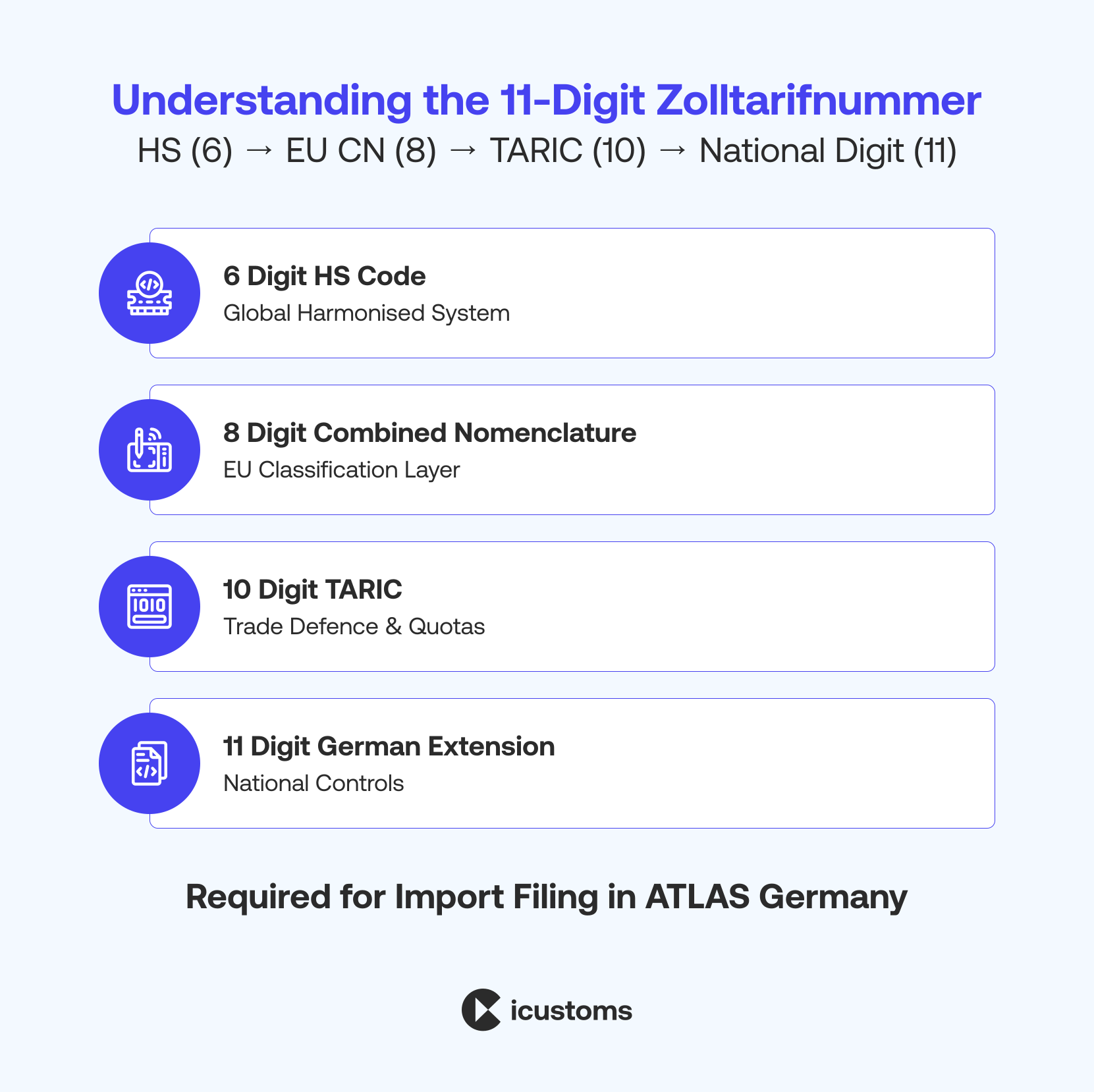
The German Zolltarifnummer is structured progressively from global classification to EU and national measures.
- Digits 1 to 6 derive from the Harmonised System
• Digits 7 and 8 represent the EU Combined Nomenclature
• Digits 9 and 10 encode TARIC measures such as anti dumping duties, quotas, or suspensions
• Digit 11 reflects national specifications applied in Germany
For imports into Germany, the full 11 digit code must be declared in ATLAS. For exports, the 8 digit Combined Nomenclature code is generally sufficient.
This distinction explains why import declarations are more sensitive to extended digit precision.
General Rules for Interpretation and Classification Discipline
Classification under the Combined Nomenclature follows legally binding General Rules for Interpretation, commonly referred to as GRI 1 to 6.
These rules determine how goods are classified when:
- Products appear to fall under multiple headings
• Goods are incomplete or unfinished
• Composite or mixed products are involved
• Sets or combined items must be assessed
Classification therefore requires legal methodology, not solely commercial description. For high-volume operators managing diverse SKUs, inconsistent interpretation across teams can generate cumulative compliance exposure.
Binding Tariff Information and Legal Certainty
Economic operators may request Binding Tariff Information from customs authorities to obtain formal classification certainty for specific goods.
Binding Tariff Information:
- Provides legally binding classification decisions
• Applies to goods matching the described technical characteristics
• Protects against reclassification during its validity period
However, it does not replace internal governance. For operators handling thousands of product variations, structured and consistent classification processes remain essential.
Why This Legal Structure Matters for ATLAS and ICS2
Because Germany’s tariff framework:
- Is harmonised at EU level
• Is updated annually
• Encodes trade defence and quota measures at detailed digit levels
• Requires 11 digit precision for imports
ATLAS validation is necessarily strict. Misclassification is not simply a documentation error. It is a breach of a harmonised tariff structure embedded in the EU Customs Code architecture.
For B2B operators moving goods between the UK, EU, and US, tariff precision is therefore a structural compliance requirement integrated into Germany’s digital customs systems.
Structured Automation for Germany’s ATLAS & ICS2 Environment
Germany’s customs infrastructure is built on structured electronic validation. ATLAS does not assess declarations informally; it processes structured datasets against defined tariff logic, procedural rules, and risk parameters. ICS2 performs similar validation at the security layer before goods physically arrive.
In this environment, compliance failures are rarely caused by ignorance of rules. They are typically the result of fragmented data handling, inconsistent classification governance, or manual re-entry across multiple systems.
For high-volume operators, the challenge is not filing a declaration, it is maintaining structured consistency across thousands of submissions.
Controlling Tariff Precision at 10–11 Digit Level
Germany applies extended tariff precision through the Zolltarifnummer. While the 6-digit HS code may be correct, errors at the 10th or 11th digit can alter duty treatment, trigger trade defence measures, or multiply fixed per-heading charges under low-value reforms.
Maintaining classification consistency across shipments, teams, and EU jurisdictions requires more than static reference tables.
iClassification enforces structured tariff logic at extended digit level, ensuring consistent assignment across import, export, and ENS filings. This reduces classification variance, strengthens audit traceability, and limits exposure to misapplied measures.
Eliminating Invoice-to-Declaration Data Gaps
One of the most common root causes of ATLAS rejection cycles is inconsistency between commercial documentation and declared data. Manual extraction from invoices introduces errors in:
- Commodity descriptions
- Declared values
- Consignee identifiers
- Origin references
These discrepancies become visible when ICS2 data and ATLAS declarations are compared. iDP (Intelligent Document Processing) structures invoice and transport data directly at source, transforming unstructured documents into declaration-ready datasets. By standardising data before submission, operators reduce valuation errors and cross-system mismatches.
Synchronising ENS and ATLAS Submissions
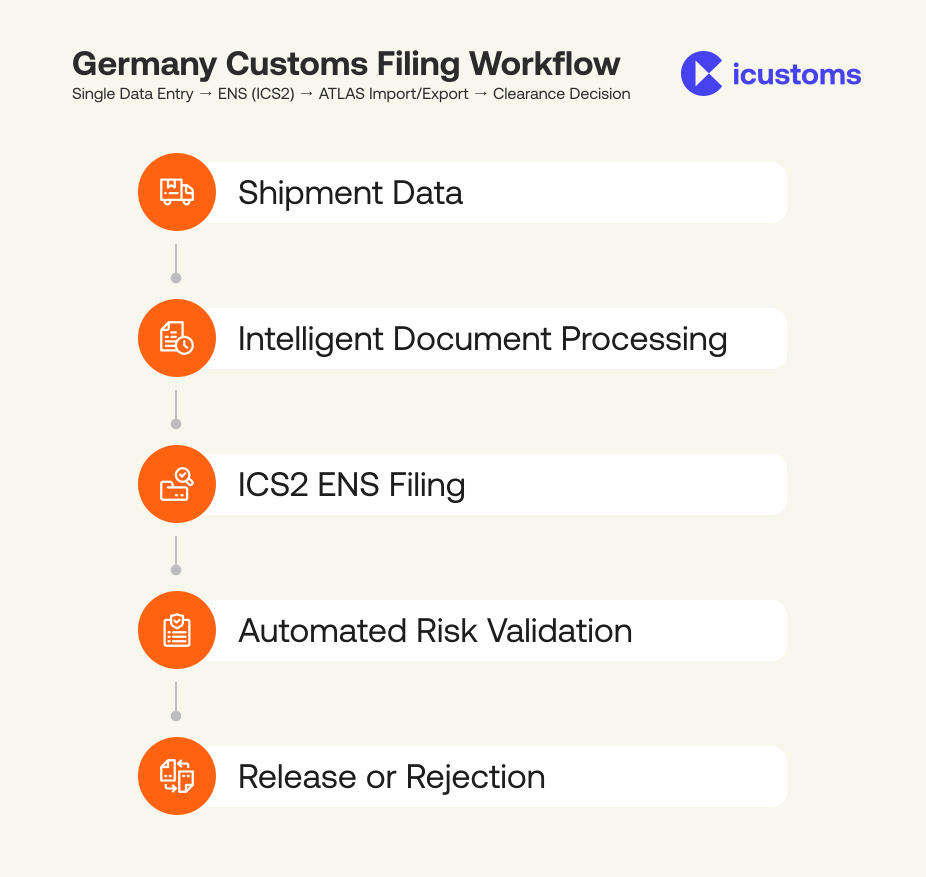
ICS2 and ATLAS operate independently but evaluate overlapping data elements. Differences in commodity description, value, or classification between pre-arrival ENS and formal customs declaration increase the probability of risk referral or inspection.
A fragmented workflow, where security and customs filings are prepared separately, increases inconsistency risk.
A unified customs workflow ensures shipment data is entered once and reused across:
- Import declarations
- Export declarations
- Entry Summary Declarations (ENS)
By synchronising filings from a single structured dataset, operators reduce amendment cycles and maintain cross-system consistency.
Reducing Germany Customs Rejection Through Pre-Submission Validation
ATLAS rejection is not merely administrative inconvenience. It results in:
- Amendment resubmissions
- Terminal storage exposure
- Labour reallocation
- Scheduling disruption
Pre-submission validation acts as a control layer between internal shipment data and German customs systems. Structured checks identify inconsistencies before transmission, shifting compliance from reactive correction to proactive validation. This improves clearance predictability and reduces operational volatility, resulting in fast Germany customs clearance.
From Manual Customs Filing to Structured Control
As Germany’s customs systems continue aligning with EU-wide digital reform, tolerance for inconsistent datasets will decline further. Increased data reconciliation between customs, security, and VAT systems will expose fragmented processes more rapidly.
For logistics operators managing high-throughput trade flows, digital maturity in customs is no longer a matter of efficiency, it is a matter of risk control.
Structured automation enables:
- Consistent tariff governance
- Clean document-to-declaration workflows
- Harmonised ENS and ATLAS submissions
- Reduced rejection exposure
- Scalable compliance architecture
In Germany’s data-driven customs environment, control over structured data is the defining factor between reactive correction and predictable clearance performance. Explore how structured customs automation can strengthen operational resilience across Germany’s ATLAS and ICS2 systems.
How iCustoms Solves Germany Customs Challenges
iCustoms is designed not merely as a form-filling interface but as a structured compliance layer aligned with ATLAS and ICS2 requirements for Germany customs. By ingesting shipment data once and reusing it across import, export, and ENS filings, the platform reduces duplication and inconsistency.
Intelligent Document Processing extracts structured data from invoices and transport documents, while iClassification supports consistent tariff assignment with audit traceability. Instead of correcting errors after rejection, data is validated before submission. This shift from reactive correction to proactive validation improves:
- Release predictability
- Reduction in rejection cycles
- Cross-border data consistency
- Operational visibility across EU jurisdictions
EU-Wide Customs Filing from a Single Platform
Germany rarely operates in isolation. Logistics operators frequently handle multi-country filings across the EU, each with its own national digital interface. Fragmented systems create inconsistent classification logic and duplicated workflows.
A harmonised compliance platform enables operators to manage Germany alongside other Member States using consistent structured data principles. This reduces fragmentation, improves oversight, and strengthens resilience across multi-modal transport flows.
iCustoms provides logistics operators with a scalable, structured foundation for managing Germany’s customs requirements today while preparing for deeper EU-wide digital integration tomorrow.
FAQs: Germany Customs, ATLAS, ICS2 & Zolltarifnummer
What is ATLAS in Germany customs?
ATLAS is Germany’s digital customs platform used to submit and validate import and export declarations before goods are cleared.
What is ICS2 in EU customs?
ICS2 is the EU’s pre-arrival security system that requires shipment data submission for risk assessment before goods reach the border.
What is a Zolltarifnummer?
A Zolltarifnummer is Germany’s 10–11 digit tariff code used to calculate duties, VAT, and apply trade measures.
Why is HS code accuracy important in Germany?
Accurate classification ensures correct duty calculation and prevents delays. iCustoms uses AI classification to maintain consistency at extended digit level.
What happens if ATLAS rejects a declaration?
The shipment is held until errors are corrected and resubmitted, causing delays and additional operational costs.
Is IOSS enough for Germany customs compliance?
No. IOSS only simplifies VAT collection. ATLAS declarations and ICS2 ENS filings are still mandatory for import clearance.
What is the €3 duty rule in Germany?
For low-value imports under €150, a fixed €3 duty applies per tariff heading, increasing costs if goods are classified under multiple headings.
Why must ICS2 and ATLAS data align?
Mismatch between filings increases risk flags and delays. iCustoms ensures a single structured dataset is reused across both systems.
How can businesses reduce customs delays in Germany?
Delays are reduced by improving data quality and automation:
- Accurate tariff classification
- Clean invoice-to-declaration data
- Pre-submission validation
iCustoms enables all three through a unified compliance workflow.
What is the role of Zoll in Germany customs?
Zoll is the German customs authority responsible for enforcing EU trade laws, duties, and border security controls.
What is ENS in ICS2?
ENS, Entry Summary Declaration, is the dataset submitted before arrival to enable EU customs risk analysis.
What is the difference between HS code and Zolltarifnummer?
HS code is a global 6-digit system, while Zolltarifnummer extends it to 10–11 digits for EU and Germany-specific measures.
What software is used for Germany customs declarations?
Modern businesses use platforms integrated with ATLAS and ICS2. iCustoms provides AI-driven filing, classification, and document processing in one system.
Why is automation important for Germany customs?
Automation improves accuracy, reduces rejection rates, and ensures scalable compliance across high-volume shipments.

Simplify Germany Customs Compliance
Automate ATLAS declarations, ICS2 filings, and Zolltarifnummer classification with iCustoms to reduce errors, prevent delays, and maintain full compliance at scale.
You may also like:

Struggling to Extract, Catagorise & Validate Your Documents?

Capture & Upload Data in Seconds with AI & Machine Learning
Subscribe to our Newsletter
About iCustoms
iCustoms is an all-in-one solution helping businesses automate customs processes more efficiently. With AI-powered and machine-learning capabilities, iCustoms is designed to streamline your all customs procedures in a few minutes, cut additional costs and save time.
Struggling to Extract, Catagorise & Validate Your Documents?
Capture & Upload Data in Seconds with AI & Machine Learning