
The Silent Profit Killer: Hidden Costs of Manual Customs Filing
- John Hall
- Customs Specialist at iCustoms.ai
If you’re running a business that ships goods across borders, you know the drill. In addition to packing boxes and entertaining customers, customs declarations are an unavoidable and frequently dreaded task.
For many growing businesses, the default method is manual. It starts simple: an Excel spreadsheet, a dedicated staff member, and a whole lot of concentration. It seems like the simplest option, right?
But what if that spreadsheet and manual process are quietly costing you a lot?
The true price of manual customs filing isn’t just an employee’s salary. It’s a collection of hidden costs, financial leaks, and operational drags that can seriously hamper your growth.
How does manual customs filing kill profits?
Let’s break down how manual or traditional customs processes cause financial strains:
The human error
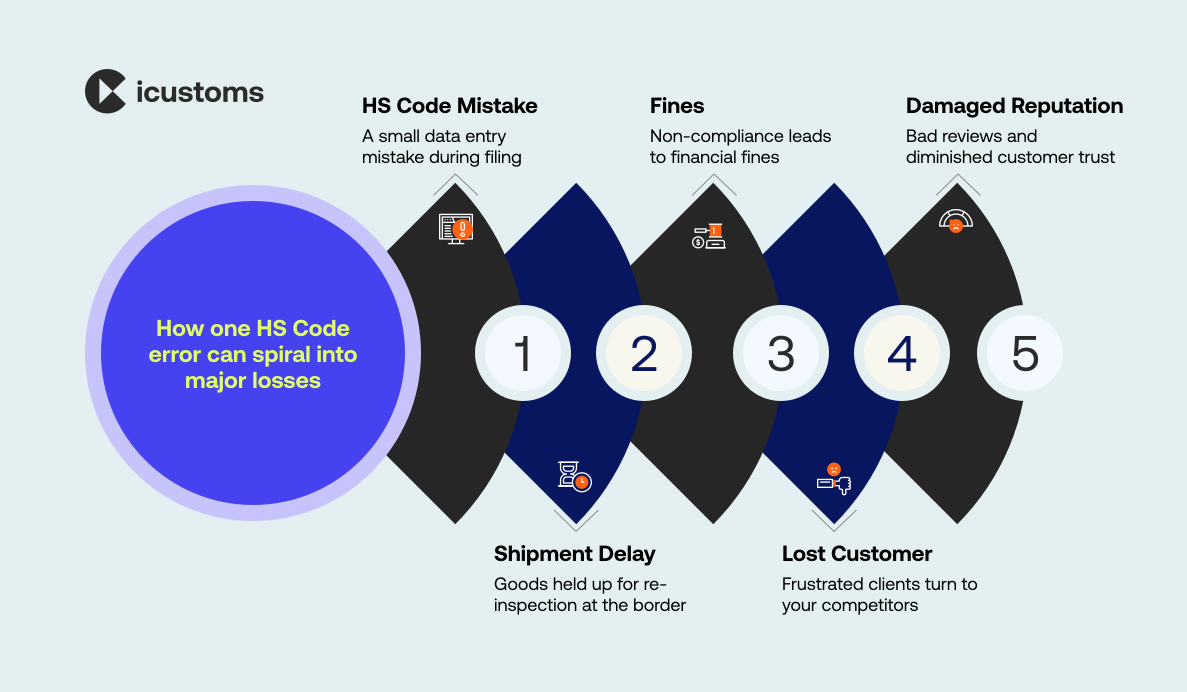
We’re all human. We make typos. We get distracted. But in the world of customs, a simple mistake isn’t so simple. Transposing two numbers in a Harmonised System (HS) code, misspelling a recipient’s name, or entering the wrong value for goods can have a costly domino effect:
- Shipment delays: Customs authorities don’t make assumptions. An incorrect form is a red flag, leading to your shipment being held for inspection. Days, or even weeks, can pass while it’s sorted out.
- Fines and penalties: A mistake isn’t just an inconvenience; it can be seen as a non-compliance issue. This can lead to unexpected fines that eat directly into your profit margins.
- Damaged reputation: What happens when your customer’s urgent delivery is stuck at the border? They don’t blame the complexities of customs law; they blame you. A delayed shipment can lead to a lost customer and a negative review.
The productivity drain and opportunity cost
Let’s say you have a skilled team member, Sarah, handling your customs declarations. She spends hours each week meticulously entering data, cross-referencing codes, and triple-checking forms.
The obvious cost is her time. The hidden cost is what Sarah isn’t doing.
Instead of navigating complex tariff codes, she could be:
- Improving customer relationships.
- Negotiating better rates with carriers.
- Streamlining your warehouse logistics.
- Analysing sales data to find new growth opportunities.
Manual customs filing turns valuable, strategic thinkers into data-entry clerks. It’s low-value work that prevents your best people from doing the high-value work that actually grows your business.
Missed opportunity for duty reduction schemes
When you’re processing customs manually, the focus is often on speed, not strategy. But this rush means you’re probably overlooking schemes that could significantly reduce your duties and taxes.
What you could be missing:
- Preferential Tariffs under free trade agreements that eliminate or reduce duties.
- Inward Processing Relief (IPR) for goods temporarily imported and re-exported.
- Customs Warehousing to delay duty payment until goods are sold.
Each of these options requires documentation, consistent recordkeeping, and monitoring, something that manual processes struggle to deliver.
The result? You’re paying more tax than you legally have to, simply because there’s no system in place to flag saving opportunities.
Late shipments cause financial losses
Late shipments not only cause inconvenience for customers, but they also cost you money.
Financial consequences of delays include:
- Late delivery penalties: Some B2B contracts include service-level agreements (SLAs) with financial penalties for late deliveries.
- Customer churn: Delayed shipments damage customer relationships. Losing a key account over a late delivery is more expensive than a one-off fine.
Manual customs processes create more risk for errors, and every delay caused by those errors has a real price tag.
Lack of visibility that leads to reactive spending
Manual customs processes typically lack real-time tracking, document traceability, or performance metrics. You can’t see where things are going wrong until they’ve already gone wrong.
That lack of visibility leads to:
- Emergency costs: Rushed document retrieval, last-minute courier fees, or emergency broker services to fix or resend entries.
- Unpredictable cash flow: Without accurate landed cost forecasting, your finance team may struggle with budgeting and cost allocation.
- Redundancy and duplication: Without centralised data, departments often recreate the same documentation multiple times, wasting both time and money.
In short, without insights, you end up firefighting, and firefighting always costs more than prevention.
Inability to scale without inflated operating costs
Manual customs processes may work when you’re small, but they don’t grow with you. If your business doubles its order volume, your filing process doesn’t magically speed up.
Here’s what typically happens:
- Hiring new staff: You bring in more admin staff just to keep up, rapidly increasing your overheads.
- Training costs: New team members need time and money to get up to speed, and manual processes have no standardised workflows or documentation.
- Process bottlenecks: One absent employee or a sick day can bring your shipping schedule to a halt, leading to lost revenue and customer dissatisfaction.
Without automation, scaling becomes exponentially expensive.
Poor recordkeeping that exposes you to costly audits
Manual filing systems often mean documents scattered across inboxes, folders, and desktop files. There’s no consistent archiving, no automatic logs, and no audit trail.
What this exposes you to:
- Inability to prove compliance: If HMRC or another customs authority audits your entries, you must be able to produce supporting documents within a specific time window.
- Lost claims: You may be unable to file duty reclaims, appeals, or VAT refunds because you can’t locate required evidence.
- Administrative backlog: Even internal audits become costly when your team has to hunt down months of paperwork just to answer basic questions.
Bad documentation doesn’t just hurt you in audits; it actively prevents cost recovery and exposes you to unnecessary liabilities.
Wrapping up: Manual = Money drain
What seems like a cost-saving shortcut is often a hidden money pit. With manual customs filing, you’re not just spending more time; you’re spending more money in ways that are harder to spot:
- Fines and penalties
- Higher labour costs
- Delayed shipments
- Overpaid duties
- Missed cost-saving schemes
- Emergency fixes
- Bottlenecks and burnout
And the longer you wait to modernise, the more those costs accumulate.
What can you do?
Investing in digital customs software might feel like a big step, but the return is measurable:
- Fewer errors, fewer fines
- Faster processing, lower labour costs
- Built-in compliance checks
- Visibility across the supply chain
- Eligibility tracking for duty-saving schemes
- Scalable processes for future growth
You may also like:
Simplify Customs with our Powerful Customs Management Software

Automate declarations, track shipments, & ensure compliance.
About iCustoms
iCustoms is an all-in-one solution helping businesses automate customs processes more efficiently. With AI-powered and machine-learning capabilities, iCustoms is designed to streamline your all customs procedures in a few minutes, cut additional costs and save time.
Simplify Customs with our Powerful Customs Management Software
Automate declarations, track shipments, & ensure compliance.