

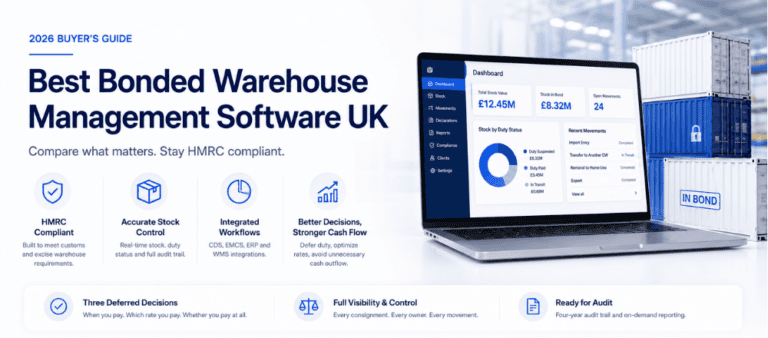
Best UK Customs Management Software: Reviewed and Compared
-
 Freya Jane
- Director of Customer's Success
The UK customs management software market is growing fast, and for good reason. Since the United Kingdom’s transition from CHIEF to the Customs Declaration Service (CDS) in November 2023, every UK business involved in importing or exporting must use software that is compatible with HMRC’s CDS system. Getting this wrong means delayed shipments, compliance penalties, and failed customs submissions.
This guide compares the best UK customs management software platforms. We cover features, UK regulatory compliance, pricing models, and the use cases each platform is best suited for, so you can make an informed decision without wading through vendor marketing materials.
iCustoms is listed on the HMRC approved software register for UK Customs Declaration Service (CDS) submissions. All declarations processed through iCustoms are submitted directly to HMRC via approved channels.
What Is Customs Management Software?
Customs management software is a digital platform that helps UK businesses prepare, validate, and submit customs declarations to HMRC and other border agencies. It automates the classification of goods (using HS codes and commodity codes), calculates import duties and VAT, manages compliance with trade regulations, and transmits declaration data electronically to HMRC’s Customs Declaration Service.
Good customs software does far more than submit forms. It tracks the Movement Reference Number (MRN) for each declaration, flags compliance errors before submission, manages safety and security declarations (Entry Summary Declarations, or ENS), supports NCTS transit declarations for goods moving through the UK under transit procedures, and provides an audit trail for HMRC query purposes.
For UK businesses, the core requirement since January 2021 is CDS compatibility. HMRC’s Customs Declaration Service replaced the legacy CHIEF (Customs Handling of Import and Export Freight) system for imports in November 2023, and for exports in March 2023. Any customs software that does not support CDS is now non-functional for UK customs submissions.
UK Regulatory Context: What Your Customs Software Must Support
Before evaluating any customs management platform, UK businesses should confirm that the software supports the following HMRC and UK border systems. These are not optional extras. They are the baseline requirements for legal customs compliance in the UK.
| Regulatory System | What It Is and Why It Matters |
| HMRC Customs Declaration Service (CDS) | Replaced CHIEF for all UK import declarations from November 2023 and export declarations from March 2023. All UK customs software must support CDS. Non-CDS software cannot legally submit UK customs declarations. |
| NCTS Phase 5 (New Transit System) | The EU and UK system for managing goods in transit. Phase 5 went live in November 2023 in the UK and January 2024 in the EU. If your business moves goods in transit, your software must support NCTS Phase 5. |
| ENS (Entry Summary Declaration) | Safety and security declarations required for all goods arriving in Great Britain from outside the UK. Must be submitted in advance of arrival. Required for air, sea, and Channel Tunnel freight. |
| GVMS (Goods Vehicle Movement Service) | HMRC’s system for linking customs declarations to vehicle movements at ports. Relevant for road haulage and short-sea ferry operators. |
| ICS2 (Import Control System 2) | The EU’s advance cargo information system. Required for shipments entering the EU. Relevant to UK exporters shipping to EU countries. |
| Safety and Security GB Declarations | Required for certain goods exported from Great Britain. Processed separately from the main export declaration. |
"Customs represent the experience of mankind"

Key Features to Look For in UK Customs Management Software
When evaluating customs management software, UK buyers should assess the following capabilities. Not all platforms support all features. The right software depends on your declaration volumes, the complexity of your supply chain, and whether you are operating as a trader, freight forwarder, customs agent, or logistics provider.
- CDS declaration submission: The software must be certified for direct submission to HMRC’s CDS. Confirm whether the platform submits declarations itself or routes through a community system provider (CSP). Both methods are valid but have different reliability and speed characteristics.
- Tariff classification and HS code lookup: Quality customs software includes a tariff classification tool that allows users to search for the correct commodity code for their goods. AI-powered classification tools (like iCustoms iClassification) automate this by reading product descriptions and returning the most likely HS code.
- Import duty and VAT calculation: The software should calculate the exact duty liability based on commodity code, customs value, country of origin, and any applicable preferential trade agreement rates (for example, UK-EU TCA or UK-Japan CEPA).
- Full duty management software capability goes beyond calculation it includes deferment account management, duty suspension under inward processing relief (IPR), postponed VAT accounting (PVA) handling, and duty reclaim identification for historically misdeclared commodity codes. iCustoms iCalculator covers duty and VAT calculation with trade agreement rate application as standard.
- NCTS Phase 5 transit declarations: If you move goods in transit under the Common Transit Convention, your software needs NCTS Phase 5 support as of November 2023.
- ENS and safety and security declaration support: Post-Brexit, all goods entering Great Britain require advance ENS submissions. Your software should handle these alongside the main import declaration.
- Batch declaration processing: For high-volume operators submitting dozens or hundreds of declarations per day, batch filing capability is essential. iCustoms iZap provides batch ENS and CDS filing that significantly reduces processing time.
- Document processing and data extraction: Intelligent document processing (IDP) reads commercial invoices, packing lists, bills of lading, and other shipping documents to auto-populate declaration fields. This eliminates manual data entry and reduces error rates.
- When evaluating the best customs document processing software, the differentiator is not just OCR text reading it is whether the platform can classify document types, validate extracted values against tariff and regulatory rules, and route confirmed data directly into CDS declaration fields in a single automated step. iCustoms IDP does all three.
- ERP and logistics system integration: Enterprise users need their customs software to connect with SAP, Microsoft Dynamics, Oracle, and freight management systems via API or EDI.
- Compliance checking before submission: The software should validate each declaration against HMRC’s CDS business rules before submission, catching errors that would otherwise result in rejection or delay.
- Audit trail and reporting: HMRC may audit any declaration up to four years after submission. The software should maintain a complete, searchable audit trail of all declarations, amendments, and communications.
Best UK Customs Management Software: Top Platforms Compared

The following platforms represent the main options available to UK businesses evaluating customs management software. Each has different strengths, target markets, and pricing models. Read each summary carefully to identify which platform best matches your specific operational requirements.
1. iCustoms: AI-Powered UK Customs Declaration Software

Best for: SME importers and exporters, freight forwarders, customs agents, and supply chain businesses requiring CDS, ENS, and NCTS declarations with AI automation.
iCustoms is a UK-based customs declaration platform built specifically for the post-Brexit CDS environment. It is HMRC-approved and handles the full range of UK customs declaration types, including import and export CDS declarations, safety and security ENS declarations, and NCTS Phase 5 transit declarations.
What sets iCustoms apart from established UK customs software vendors is its use of intelligent document processing (IDP). Rather than requiring users to manually enter data from commercial invoices, packing lists, and shipping documents, iCustoms reads these documents automatically and pre-populates the declaration fields. For businesses processing high document volumes, this reduces declaration preparation time by 60 to 80 percent compared with manual entry.
As a complete HMRC customs document automation solution, iCustoms takes this further the extracted document data is validated against HMRC’s CDS business rules before submission, and the accepted declaration is transmitted directly to HMRC via the approved CDS API, with the MRN returned and stored automatically against the declaration record.
The iCustoms product suite includes iWiz, a guided declaration wizard that walks users through the entire CDS submission process step by step, making it accessible to businesses without a dedicated customs professional on staff. iZap handles batch ENS and CDS declaration filing for high-volume operators. iNCTS manages NCTS Phase 5 transit declarations. The iClassification AI tool assists with HS code and commodity code assignment for complex goods.
iCustoms pricing follows a transparent per-declaration model with volume discounts. Unlike enterprise customs software vendors who require a full sales process before revealing pricing, iCustoms publishes its pricing structure so businesses can calculate costs before committing.
| Feature | iCustoms Capability |
|---|---|
| CDS Declaration Support | Yes, HMRC approved |
| ENS Safety and Security Declarations | Yes, via iZap |
| NCTS Phase 5 Transit | Yes, via iNCTS |
| AI Document Processing (IDP) | Yes, core feature |
| AI HS Code Classification | Yes, iClassification tool |
| Batch Declaration Filing | Yes, via iZap |
| Guided Declaration Wizard | Yes, iWiz |
| Pricing Model | Per-declaration, transparent published pricing |
| UK or EU Focus | UK specialist, also covers EU ICS2 requirements |
| HMRC Approved | Yes |
Manage documentation, goods classification, and customs declaration in a single platform.
2. Descartes Customs Management (formerly AEB)

Descartes Systems Group is a Canadian-headquartered logistics technology company that acquired AEB GmbH (Automated Export Business) in 2023. The combined platform is now positioned as Descartes Customs and Regulatory Compliance, covering customs management for over 160 countries including the UK and EU.
The Descartes customs platform is particularly strong on export control and sanctions screening. For businesses exporting controlled goods or operating in regulated sectors, Descartes provides restricted party screening against global sanctions lists and automated export licence determination. For UK businesses with simpler CDS declaration needs and no cross-border complexity, Descartes is likely overspecified and priced above what is necessary.
Pricing for Descartes is enterprise contract-based and requires a full sales engagement before any figures are disclosed. Implementation timelines for enterprise deployments are typically measured in months. SME and mid-market UK traders will find iCustoms or a UK-specialist platform faster to deploy and more cost-effective.
3. CargoWise by WiseTech Global

CargoWise is an Australian-developed, globally deployed logistics platform. Its customs module supports UK CDS declarations, NCTS transit, and ENS safety and security filings. CargoWise is best understood as a full logistics operating system rather than a specialist customs tool. Its customs capability is comprehensive but is delivered as part of a much larger platform.
For businesses that are primarily evaluating customs software and do not need a full TMS and freight management platform, CargoWise represents a significant over-investment in implementation time, training, and cost. The platform is typically deployed by large freight forwarders who need customs capability alongside warehouse management, air and ocean freight, and invoicing within a single system.
CargoWise pricing is module-based and volume-driven. Implementation requires specialist CargoWise partners and takes several months for large deployments. Smaller UK businesses and customs agents will find more agile and cost-effective options in UK-native platforms.
4. ASM Customs (Automated Customs and Border Systems Ltd)

ASM stands for Automated Customs and Border Systems Ltd. It is a UK customs software company established in 1993 with a long history of HMRC integration. ASM provides UK customs declaration software covering CDS import and export declarations, tariff classification, licence management, and customs data reporting. It is not to be confused with ‘agency sector management’, which is an unrelated concept in public sector administration.
ASM is a well-regarded platform in the UK customs agent community and is used by a significant number of established freight forwarders and third-party customs filing agents. Its strength lies in its depth of UK tariff and licensing data and its long operational history with HMRC systems.
From an iCustoms competitive perspective, ASM’s traditional workflow requires significant manual input, and its interface reflects its long development history. iCustoms IDP automation and AI classification offer a modernised alternative for businesses seeking to reduce manual processing overhead.
5. Thyme IT:

Thyme IT is a UK-based provider of customs and freight software, focused on supporting customs declaration workflows and integration with HMRC systems. Its solutions are typically used by customs agents, freight forwarders, and logistics operators handling UK import and export processes.
The platform supports core UK customs requirements, including CDS declaration submissions and integration with related border systems. Thyme IT is generally positioned as a traditional customs software provider, with functionality centred on structured data input, compliance processing, and system connectivity.
Compared with newer platforms, Thyme IT follows a more conventional approach to customs processing, with less emphasis on AI-driven automation or document-based data extraction
Customs Management Software For Freight Forwarders
Freight forwarders are typically responsible for both carrier-level and house-level customs declarations across multiple client accounts simultaneously. The primary requirements are: high-volume batch filing capability, multi-client management dashboards, multiple ENS filing coordination, and CDS API integration. iCustoms iZap addresses high-volume batch processing while the multi-client dashboard enables forwarders to manage compliance across all client accounts from a single login.
Customs Management Software For Hauliers and Road Carriers
Since ICS2 Release 3 came into full effect in September 2025, road carriers entering the EU must file ENS declarations for every movement. Combined with UK CDS export declaration obligations, road hauliers now face dual filing requirements for every EU-bound load. iCustoms automates both: CDS export declarations on the UK side and ICS2 ENS filings on the EU side, with ELO generation for French border crossings included as standard.
Customs Management Software For Customs Brokers
Customs brokers require the full breadth of declaration capability: CDS import and export declarations, NCTS transit filings, ICS2 ENS safety and security declarations, and AI tariff classification for diverse goods categories across multiple clients. iCustoms provides all of these through a single platform with iNCTS for transit filings and iClassification for automated HS code assignment, reducing the manual workload of classification and allowing brokers to focus on complex, high-value declaration work.
Customs Management Software For Importers and Exporters (SMEs)
Small and medium-sized UK businesses importing from the EU, the US, or Asia post-Brexit often find themselves filing customs declarations for the first time. The priority for SME buyers is accessibility, accuracy, and cost-effectiveness. iWiz provides a guided, step-by-step declaration process with real-time data validation that makes accurate CDS filing achievable without extensive customs expertise. iClassification removes the most common SME error — incorrect HS codes — by automating commodity code assignment from product descriptions.
Customs Management Software Comparison Table
The following comparison covers the most important features for UK buyers evaluating customs management software. A checkmark indicates the feature is available. A partial indicator means limited or basic support is provided.
| Feature | iCustoms | Descartes (AEB) | CargoWise | ASM Customs | Thyme IT |
|---|---|---|---|---|---|
| HMRC CDS Declarations | Yes, HMRC approved | Yes, HMRC approved | Yes | Yes, HMRC approved | Yes |
| NCTS Phase 5 Transit | Yes, via iNCTS | Yes | Yes | Yes | Yes |
| ENS Safety and Security | Yes, via iZap | Yes | Yes | Yes | Yes |
| AI Document Processing (IDP) | Yes, core feature | Partial | No | No | No |
| AI HS Code Classification | Yes, iClassification | No | No | Tariff tool, no AI | Tariff tool, no AI |
| Batch Declaration Filing | Yes, via iZap | Yes | Yes | Yes | Yes |
| Guided Declaration Wizard | Yes, iWiz | No | No | No | No |
| ERP Integration (SAP, Dynamics) | API integration | Yes, deep ERP | Yes, deep ERP | Limited | Limited |
| Free Trial Available | Yes | No, sales-led | No, sales-led | No, demo only | No, demo only |
| Pricing Transparency | Published rates | Enterprise contract | Enterprise contract | On request | On request |
| UK or EU Focus | UK specialist, plus EU ICS2 | Global, 160 plus countries | Global | UK specialist | UK specialist |
| Best For | SME to mid market, CDS ENS NCTS with automation | Enterprise, multi country, export control | Large 3PL, full logistics platform | Established UK customs agents | Customs agents and freight forwarders needing traditional workflows |
Conclusion:
The correct customs administration software is essential for UK firms in today’s highly regulated international trade market. Some top choices are iCustoms, Descartes CustomsInfo, WiseTech Global’s CargoWise, ASM, and Thyme IT.
These programs have powerful tools that facilitate customs clearance, guarantee legality, and enhance global trade. Time, money, risk, and efficiency may all be saved and improved with the correct customs management software. If you want to succeed in the highly competitive UK market, you need to modernise your customs processes and embrace the power of technology.
Whichever platform you select, the non-negotiable requirement is that your customs compliance software is HMRC-approved for CDS submissions, actively maintained to reflect tariff and regulatory changes, and capable of handling your specific declaration types whether that is CDS import and export, NCTS transit, ICS2 ENS, or a combination of all four.
Frequently Asked Questions About ICS2
Does ICS2 apply to all UK businesses exporting to the EU?
Yes, ICS2 applies to all economic operators involved in moving goods to or through the EU, including UK-based exporters, freight forwarders, customs agents, carriers, and in some cases the final EU consignee. The obligation depends on your role in the supply chain rather than your country of establishment.
Do I need a separate EORI number for ICS2 filing?
You need an EORI number registered in one of the ICS2 countries (an EU member state, Norway, Switzerland, or Northern Ireland). UK EORI numbers issued by HMRC are not valid for ICS2 submission. If you only have a UK EORI, you will need to register for an EU EORI through the customs authority of the EU member state where you have a registered address or operate.
What happens if I miss an ICS2 filing deadline?
Missing an ICS2 filing deadline means your shipment will be subject to risk-based screening by EU customs authorities before it is released. In practice, this causes delays at the EU border, potential inspection costs, and in repeat or serious cases, fines. The severity depends on the member state and the nature of the goods.
Does ICS2 apply to goods transiting through the EU to a non-EU destination?
Yes. If your goods pass through any EU country, Norway, Switzerland, or Northern Ireland as a transit point on their way to a non-EU final destination, ICS2 filing requirements still apply. This is a frequently misunderstood aspect of the regulation that catches UK exporters shipping to Asia or the Middle East via European hub ports.
What is the best software for ICS2 filing in the UK?
iCustoms provides AI-powered ICS2 filing that completes declarations in under 90 seconds with 99% accuracy. The platform reads shipping documents automatically, applies the correct HS codes, and submits ENS data directly to the ICS2 system via the Shared Trader Interface. It is suitable for freight forwarders, customs agents, carriers, and traders of all sizes.
You may also like:
Simplify Customs with our Powerful Customs Management Software

Automate declarations, track shipments, & ensure compliance.
Subscribe to our Newsletter
About iCustoms
iCustoms is an all-in-one solution helping businesses automate customs processes more efficiently. With AI-powered and machine-learning capabilities, iCustoms is designed to streamline your all customs procedures in a few minutes, cut additional costs and save time.
Simplify Customs with our Powerful Customs Management Software
Automate declarations, track shipments, & ensure compliance.