
UKIMS and TSS: How the UK Internal Market Scheme Affects Customs Declarations
- John Hall
- Customs Specialist at iCustoms.ai
UKIMS, the UK Internal Market Scheme, is the HMRC authorisation that lets eligible businesses treat goods moving from Great Britain to Northern Ireland as not at risk of entering the EU, unlocking simplified customs processes through the Trader Support Service instead of a full declaration every time. Authorisation is free, it takes several weeks to process, and once granted it opens the door to Internal Market Movement Information and UKIMS-EIDR for eligible movements. It does not apply automatically and it does not cover every consignment: eligibility depends on your business’s compliance history, your record-keeping, and, for some goods processed in Northern Ireland, your turnover.
This guide covers what UKIMS actually requires, how to apply, what to do with the authorisation once you have it, and how it changes the declarations TSS submits on your behalf.
What UKIMS actually is
UKIMS was introduced under the Windsor Framework arrangements, most recently updated on 1 May 2025, to give businesses a way to move goods from Great Britain to Northern Ireland without the full customs formalities that would otherwise apply if the goods might go on into the EU. Authorisation lets a business declare eligible goods as not at risk, which is the decision that determines whether EU duty applies at all.
Keep UKIMS and TSS separate in your head, because they do different jobs. UKIMS is the authorisation that decides whether the lighter route is open to you. TSS is the free service you use to submit through it, whichever route applies. Holding UKIMS does not register you with TSS, and registering with TSS does not grant you UKIMS. They are two separate steps that happen to work together.
UKIMS at a glance
| Question / Answer | |
|---|---|
| What it is | HMRC authorisation enabling not-at-risk treatment for eligible GB to NI goods |
| Who runs it | HMRC, under the Windsor Framework |
| Cost | Free to apply |
| Processing time | Several weeks; apply well ahead of any planned movement |
| What it unlocks | Internal Market Movement Information and UKIMS-EIDR, for eligible goods |
| Goods covered | Standard and Category 2 goods; Category 1 goods are always excluded |
| Where it is used | Uploaded to your TSS Company Profile, declared using code NIREM on eligible items |
Who is eligible for UKIMS?
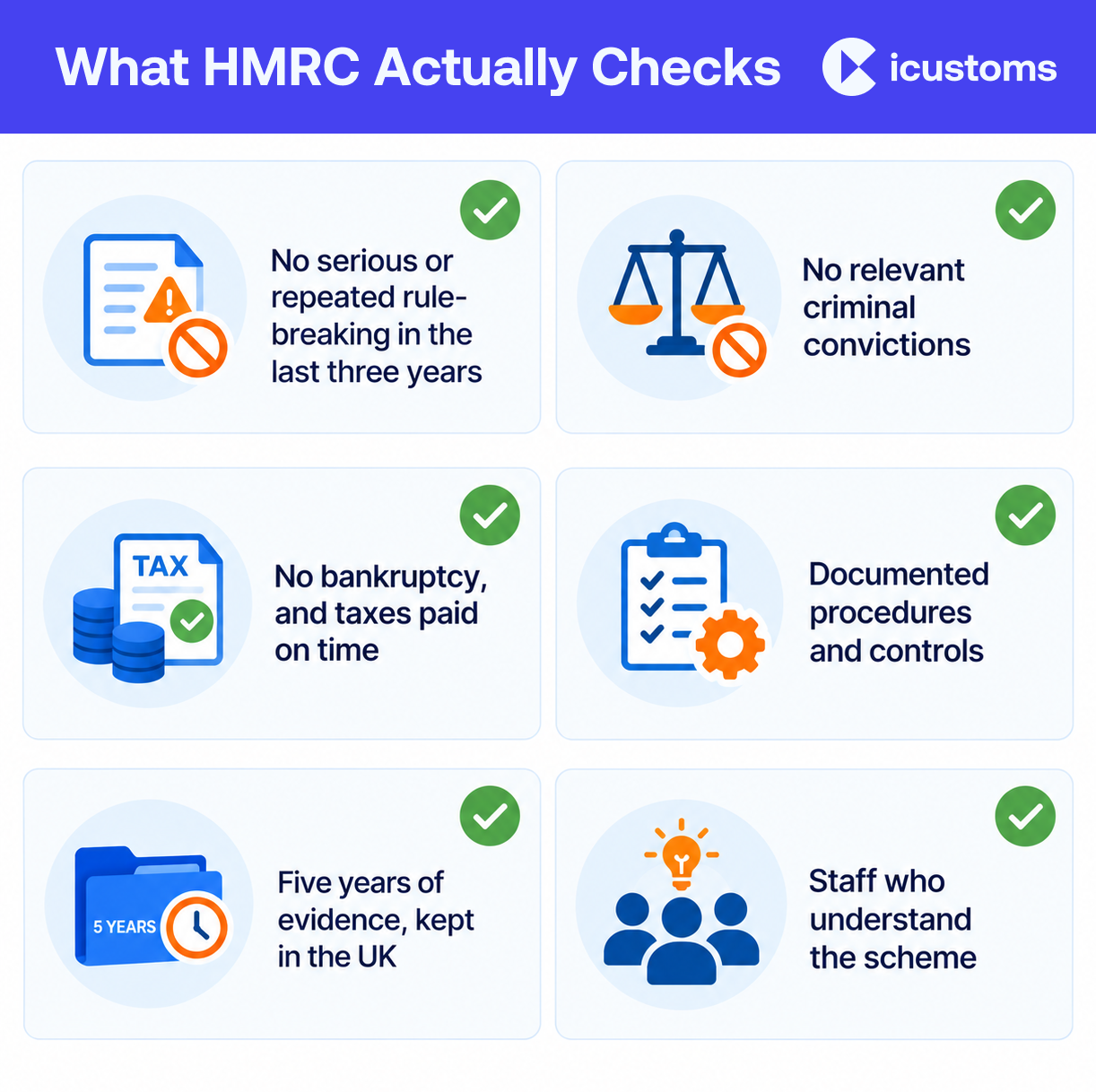
HMRC assesses the business, not just the goods. All of the following have to be true.
- No record of serious or repeated infringements of customs and tax rules over the past three years.
- No relevant serious criminal convictions tied to the business’s economic activity, covering directors and relevant staff.
- No bankruptcy proceedings, and customs duties and taxes paid on time over the past three years.
- Documented procedures and internal controls that track goods from arrival through to end use.
- Supporting evidence retained for five years, and accessible in the UK.
- Staff who understand the scheme’s reporting obligations and can demonstrate it.
Where goods are processed in Northern Ireland, a further condition applies: annual turnover under £2 million, or the goods being sheepmeat, poultry or beef imported under UK tariff rate quotas, or the processing being for an approved purpose such as food sale to UK end consumers, permanent construction, healthcare or care provision, non-profit activity without resale, or animal feed for final use in Northern Ireland.
None of this decides duty on its own. What UKIMS enables, the not-at-risk decision itself and its consequences, is covered fully in our guide to at-risk and not-at-risk goods.
How to apply for UKIMS
- Gather your EORI number, starting GB or XI, plus business, director and key personnel details, including company or taxpayer registration numbers and your incorporation date.
- Confirm the UK business premises you can offer HMRC for inspection if required.
- Prepare evidence of your records, systems and controls: how you track goods from arrival to end use, and how you catch a not-at-risk declaration that should not have been made.
- Estimate your annual not-at-risk declarations and describe the goods you intend to move, including any processing.
- Apply online. Read HMRC’s best practices guidance before you start, and save your progress as you go; the form does not have to be finished in one sitting.
- Wait. Processing takes several weeks, so apply well before you need to move goods rather than the week you need to.
Two mistakes cause most of the delay. Applicants list one contact rather than everyone in charge of the business, and director or company details that do not match Companies House exactly. Both trigger further checks. Complete every section fully: an incomplete form is treated as a reason to come back to you, not a reason to approve with gaps.
What you get, and what to do with it
A Trader Goods Profile is created automatically when a business registers for UKIMS. It holds a record for each product the business regularly moves: the goods description, commodity code, product reference, country of origin and category.
Where a profile entry exists, the person completing the IMMI can select it rather than typing the commodity data again. The commodity code, origin and description populate automatically, and what is entered by hand is the product reference or a simple description, alongside the usual commercial detail: quantity, weight, value. For a business moving the same range of products repeatedly, this is the single biggest reduction in manual entry that IMMI offers. Building and maintaining the profile properly is covered in full in TSS and the Trader Goods Profile.
Submitting before the movement
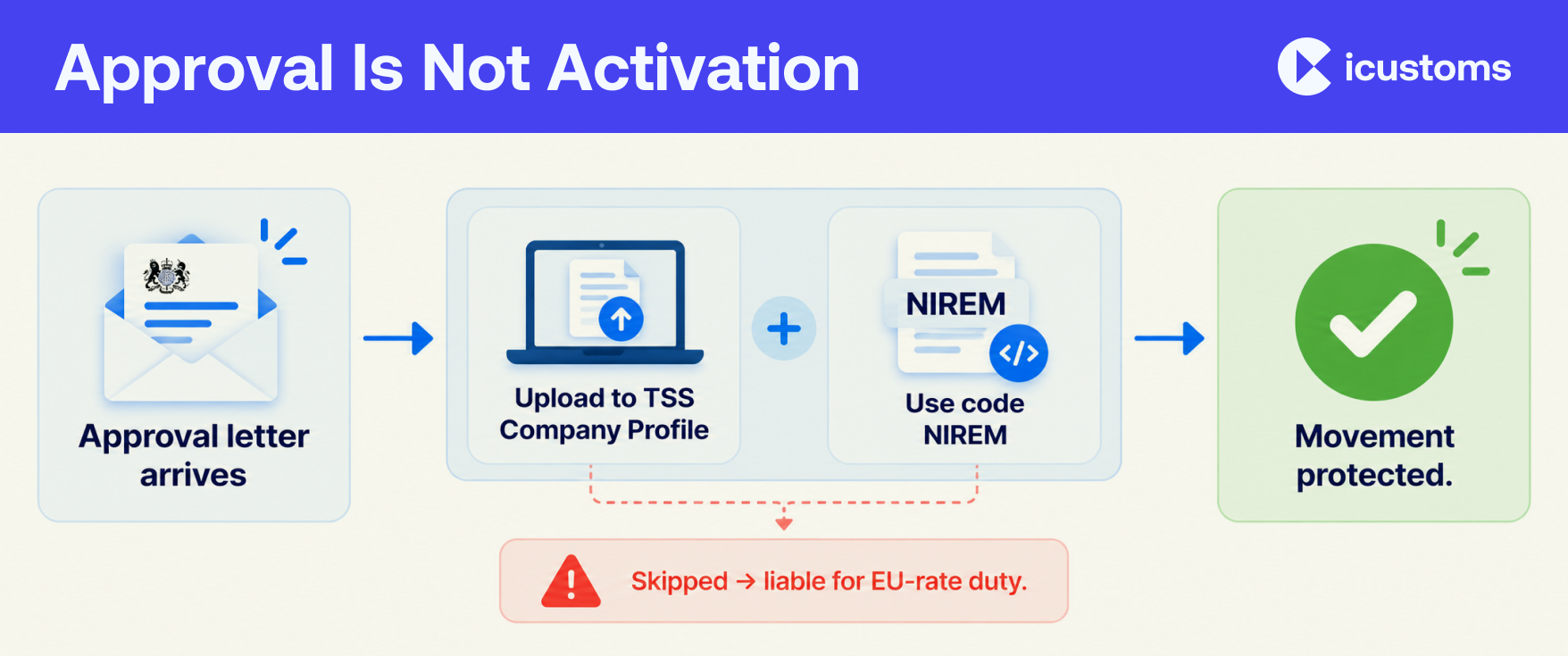
Approval arrives as a letter containing your UKIMS authorisation number. On its own, that letter does nothing for your declarations. Two further steps are required.
- Upload the authorisation letter to your TSS Company Profile.
- Use the Additional Information code NIREM on eligible goods items, to declare them not at risk.
Skip either step and the consequence is not administrative. If your UKIMS letter is not uploaded, or your authorisation was not in place at the time of the movement, you may be liable for duty at EU rates on goods that would otherwise have qualified for the not-at-risk treatment. Authorisation is not retrospective: it covers goods moved on or after the date you are authorised, not before.
On checking your number: current guidance does not describe a separate lookup service. Your authorisation letter and your TSS Company Profile are where it lives, so check there first, and contact TSS support if you genuinely cannot locate it.
How UKIMS changes what TSS submits
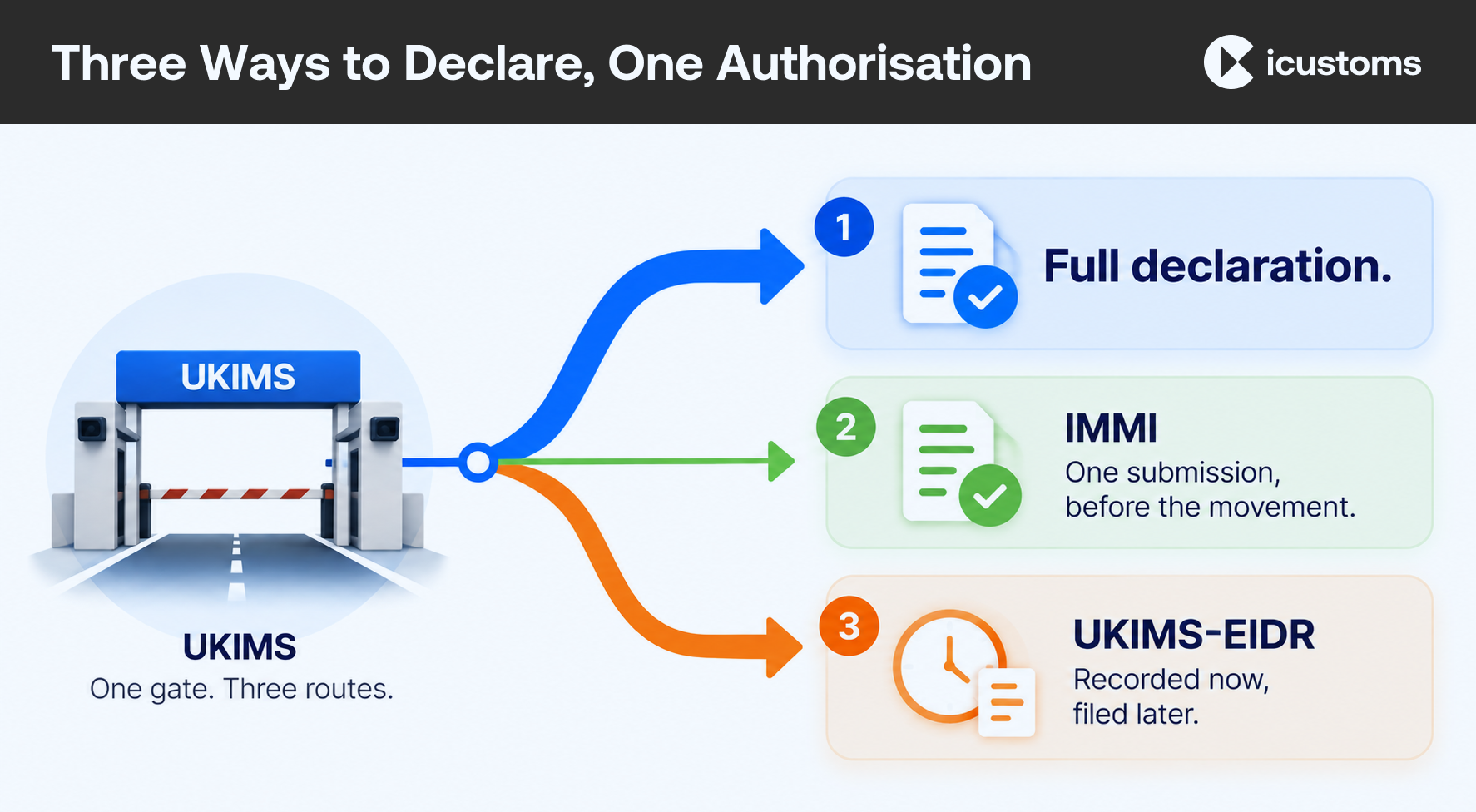
Without UKIMS, a GB to NI movement needs the TSS Simplified Procedure or a full frontier declaration, both covered in our guide to TSS declaration types. UKIMS changes the picture for eligible goods by opening two lighter alternatives.
Internal Market Movement Information, IMMI, is a single reduced submission with no supplementary declaration to follow. It is usually the lightest route available, and the full eligibility conditions and submission process are set out in TSS and IMMI.
UKIMS-EIDR is the second alternative: recording the movement in your own records at the time it happens, then submitting the fuller information afterwards. It carries its own conditions on top of UKIMS authorisation, and the full comparison with ordinary EIDR is set out in TSS EIDR explained.
Holding UKIMS authorisation is necessary for either route, but it is not sufficient on its own. The goods still have to meet the category, free circulation, direct transport and end-use conditions on every movement. Authorisation opens the door; it does not walk you through it automatically.
Which goods can actually use it
Standard and Category 2 goods are eligible where the other conditions hold. Category 1 goods are excluded outright, whatever your authorisation status, covering goods subject to trade defence measures, total bans or prohibitions, and tariff rate quotas. The full category taxonomy, with commodity code detail and worked examples, is set out in our overview of the Trader Support Service.
Common misconceptions
UKIMS covers every GB to NI movement. It does not. Category, free circulation, direct transport and end-use conditions all still apply on top of holding authorisation.
Authorisation is retrospective. It is not. It only covers goods moved on or after the date you are authorised.
Uploading the letter to TSS is optional paperwork. It is not. Without it, you may be liable for EU-rate duty on goods that would otherwise qualify.
UKIMS and TSS registration are the same application. They are not. UKIMS is an HMRC authorisation; TSS is the free service you use it through. Completing one does not register you for the other.
Frequently Asked Questions
What is UKIMS?
UKIMS, the UK Internal Market Scheme, is an HMRC authorisation that lets eligible businesses treat goods moving from Great Britain to Northern Ireland as not at risk of entering the EU, opening simplified customs routes through TSS.
What does UKIMS stand for?
UK Internal Market Scheme.
What is a UKIMS number?
The authorisation number HMRC issues in your approval letter once your UKIMS application succeeds. It has to be uploaded to your TSS Company Profile before it does anything for your declarations.
How do I register for UKIMS?
Apply online through HMRC with your EORI number, business and director details, and evidence of the records and controls the scheme requires. It is free to apply.
How long does UKIMS authorisation take?
Several weeks. Apply well ahead of any movement you are planning, not the week you need it.
Is UKIMS free?
Yes. There is no fee to apply or to hold the authorisation.
How do I check my UKIMS number?
Current guidance does not describe a separate lookup tool. It is stated on your authorisation letter and held in your TSS Company Profile.
Do I need UKIMS for every GB to NI movement?
No, but without it a movement cannot use Internal Market Movement Information or UKIMS-EIDR, and falls back to the TSS Simplified Procedure or a full frontier declaration.
What happens if I do not upload my UKIMS letter to TSS?
You may be liable for duty at EU rates on goods that would otherwise have qualified for not-at-risk treatment, even if you hold a valid authorisation.
Can Category 1 goods use UKIMS?
Category 1 goods are excluded from the simplified routes UKIMS enables, regardless of your authorisation status, and need a full customs declaration.
You may also like:
Tracking UKIMS Authorisations Across Every Client?

iCustoms keeps UKIMS numbers, TSS Company Profiles and eligibility checks in one place.
Subscribe to our Newsletter
About iCustoms
iCustoms is an all-in-one solution helping businesses automate customs processes more efficiently. With AI-powered and machine-learning capabilities, iCustoms is designed to streamline your all customs procedures in a few minutes, cut additional costs and save time.
See UKIMS Eligibility Checks Automated
Validate UKIMS status and category eligibility before you submit, not after.